

Thermal Break Aluminium Windows: Cost and ROI
- By:Naview
- Date:2026-08-01
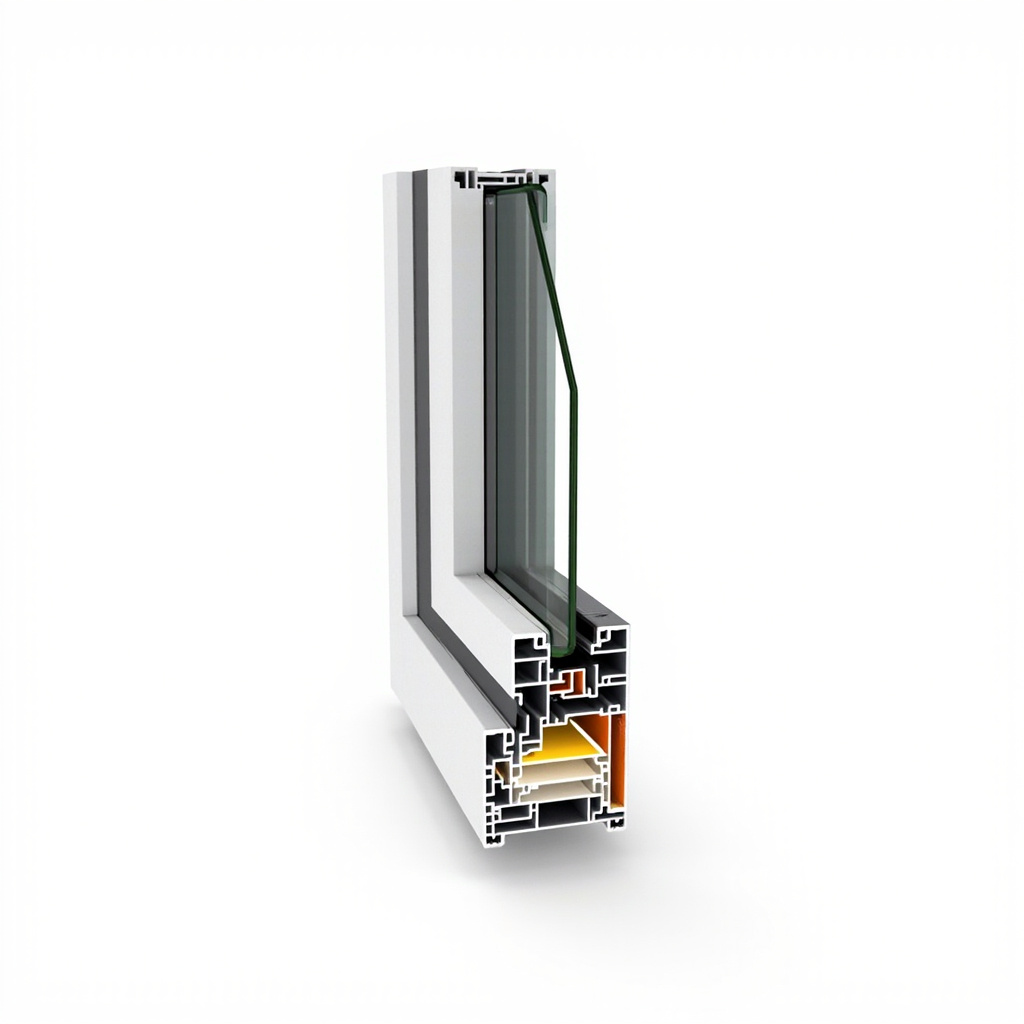
A standard aluminium window frame is a thermal highway. Without a break, heat flows straight through the metal from inside to outside — or vice versa, depending on your climate. A thermal break cuts that path by inserting a low-conductivity polyamide strip between the interior and exterior aluminium profiles. The result: a U-value drop from 5.8 W/m²K to as low as 1.6 W/m²K.
But you pay for that performance. A thermal break window costs 25-40% more than a non-thermal aluminium window of the same size. Is it worth it? In most climates with heating or cooling loads, the answer is yes — and the payback period is shorter than most project developers assume. NA-VIEW has been extruding thermal break profiles for 11 years. Here is the cost breakdown, the performance data, and the ROI calculation.
What Drives the Cost of Thermal Break Windows
A thermal break window is not just a regular aluminium window with a plastic strip slapped in. The entire profile geometry changes. You are effectively designing and extruding two separate aluminium profiles — interior and exterior — that must align perfectly to accept the polyamide strip during the rolling process. Then you need a dedicated rolling machine to insert the strip. Then you need to verify the shear strength of the composite assembly per EN 14024.
Here is where the money goes, per square metre of window opening:
| Cost Component | Non-Thermal Window | Thermal Break Window | Difference |
|---|---|---|---|
| Aluminium profiles (6063-T5) | $28-35 | $42-55 | +50-60% |
| Polyamide strips (PA66 GF25) | $0 | $6-12 | New cost |
| Thermal break rolling process | $0 | $4-8 | New cost |
| Glazing (double IGU) | $18-25 | $18-25 | Same |
| Hardware and gaskets | $12-18 | $14-20 | +10-15% |
| Fabrication labour | $15-20 | $18-25 | +15-20% |
| Total per m² | $73-98 | $102-145 | +35-40% |
These figures are based on a standard 1200×1500 mm fixed window. Openable windows (casement, tilt-and-turn) add approximately $20-35 per m² in hardware costs regardless of thermal break status.
Performance: What the Extra Cost Buys You
U-Value Comparison by Frame Type
| Frame Type | U-Value (W/m²K) | Typical Application |
|---|---|---|
| Non-thermal aluminium, single glazed | 5.8-6.2 | Not permitted in most building codes for habitable rooms |
| Non-thermal aluminium, double glazed | 3.5-4.2 | Tropical climates only |
| Thermal break aluminium (standard) | 2.2-2.8 | Temperate climates, meets minimum code |
| Thermal break aluminium (high-performance) | 1.6-2.0 | Cold climates, Passive House-adjacent |
| uPVC (for reference) | 1.4-1.8 | Cheaper but lower durability, larger frame width |
| Timber (for reference) | 1.2-1.6 | Premium, high maintenance |
The critical number to understand: dropping the frame U-value from 4.0 to 2.2 W/m²K on a building with 200 m² of window area in a heating-dominated climate saves approximately 3,600 kWh per year. At $0.15/kWh for electricity (heat pump) or $0.06/kWh for natural gas, that is $216-540 per year in energy savings — every year, for the life of the building.
Condensation Resistance
U-value is not the only benefit. The interior surface temperature of a non-thermal aluminium frame in winter can drop below the dew point, causing condensation that leads to mould and frame corrosion. A thermal break keeps the interior frame surface within 3-5°C of room temperature — above the dew point under normal humidity conditions (≤60% RH at 20°C). This is specified as the Condensation Resistance Factor (CRF) per AAMA 1503. Thermal break frames typically achieve CRF ≥ 55; non-thermal frames score CRF 25-35.
ROI: When Does Thermal Break Pay for Itself?
For a mid-rise apartment building with 800 m² of window area, the premium for thermal break over non-thermal aluminium is approximately $23,200-37,600 (at $29-47 per m² premium). Assuming a temperate climate (London, Shanghai, Melbourne) with both heating and cooling loads:
- Annual energy saving: 12,000-15,000 kWh
- Annual cost saving: $1,800-2,700 (mixed heating/cooling)
- Simple payback: 9-13 years
But this is a conservative calculation. The real ROI includes:
- Reduced HVAC sizing: Smaller heating and cooling plant — savings of $3,000-5,000 in equipment cost for the same project
- Tenant comfort and retention: No cold drafts near windows, fewer complaints, lower vacancy rates. Hard to quantify but real estate data shows thermal comfort ranks in the top 3 reasons tenants do not renew
- Building code compliance: In most jurisdictions with energy codes (ASHRAE 90.1, UK Part L, NCC Section J), you cannot meet the minimum envelope performance with non-thermal aluminium — making the “premium” a mandatory cost
For developer-built projects where the owner will hold the asset for 10+ years, thermal break windows are a no-brainer (the same logic applies to curtain wall thermal breaks we covered in the design guide).

NA-VIEW Thermal Break Profile Systems
We extrude thermal break profiles in three standard systems, covering the most common project requirements:
- 50 mm system: Frame depth 50 mm, glass thickness 4-24 mm. U-value 2.4-2.8 W/m²K (standard PA66 strip, 24 mm). Best for: apartment windows in temperate climates.
- 60 mm system: Frame depth 60 mm, glass thickness 4-32 mm. U-value 1.9-2.3 W/m²K (wider PA66 strip, 30 mm). Best for: commercial projects, cold climates.
- 70 mm system: Frame depth 70 mm, glass thickness 4-40 mm. U-value 1.6-1.9 W/m²K (multi-chamber design, 34 mm strip). Best for: Passive House projects, extreme climates.
All systems available in casement, tilt-and-turn, sliding, and fixed configurations. Custom die design: 7 days for drawing, 3 days for sampling, free of charge on orders over 5 tonnes (see our extrusion process guide for die design standards).
Common Specification Mistakes
- Specifying thermal break but not checking shear strength: A thermal break profile is only as strong as the bond between the aluminium and the polyamide strip. The shear strength must meet EN 14024 (≥24 N/mm). Ask for test reports — if your supplier cannot provide them, the thermal break may separate during fabrication or after installation.
- Mixing thermal and non-thermal profiles in the same facade: A thermal break mullion loses its effectiveness if connected to a non-thermal transom. The thermal envelope must be continuous.
- Ignoring the frame-to-wall junction: A U-value 1.8 window installed with a U-value 3.0 wall connection still creates condensation risk at the perimeter. Specify thermal break installation brackets and insulating foam backer rods at the junction.
FAQ
What is the price difference between thermal break and non-thermal aluminium windows?
Thermal break aluminium windows cost 35-40% more than non-thermal equivalents — approximately $102-145 per m² vs. $73-98 per m² for a fixed window. The premium comes from dual-profile extrusion, polyamide strip cost, and additional fabrication labour. For a typical apartment balcony sliding door (2.4×2.1 m), the thermal break premium is approximately $150-200.
Do thermal break windows meet Passive House standards?
Standard thermal break profiles (U-value 2.2-2.8) do not meet Passive House requirements (Uw ≤0.8 W/m²K for the complete window). However, our 70 mm system with triple glazing can achieve Uw 0.85-0.95 W/m²K — very close to Passive House and sufficient for most low-energy building certifications. For certified Passive House projects, we recommend combining our 70 mm profiles with warm-edge spacers and triple low-E glazing.
How long do thermal break windows last?
The aluminium frames are effectively permanent — 50+ year lifespan with basic cleaning. The polyamide strip (PA66 GF25) is UV-stable and does not degrade under normal service conditions. All NA-VIEW thermal break profiles are tested to EN 14024 for durability, including 50 thermal cycling tests (-20°C to +80°C) with no shear strength degradation.
What payment and shipping options do you offer?
Payment: T/T (30% deposit, 70% before shipment) or irrevocable L/C at sight. Shipping: FOB Shenzhen, CIF to destination port, or DDP door-to-door. Standard container delivery: 25-35 days. Free samples with mill certificates shipped within 3 working days.
CONTACT US


Foshan Naview New Building Materials Co., Ltd.
We are always here offering customers our reliable products and service.
If you want to liaise with us now, please click contact us