

Aluminium Handrail and Balustrade Systems: Design Guide
- By:Naview
- Date:2026-11-27
Every architect I work with eventually asks the same question. Which material actually survives a decade of balcony traffic? My answer rarely changes. An aluminium handrail and balustrade system, properly alloyed and coated, outlasts steel on the coast and wood almost anywhere. Our factory has extruded profiles for 30+ countries over the past 11 years. Along the way, we have shipped enough aluminium handrail and balustrade sections to fill a small marina. So this guide collects what that experience taught us. It covers loads, profiles, fixings, coatings and the buying process, written the way I would brief a project engineer.
Why an Aluminium Handrail and Balustrade System Wins on Real Buildings
Steel looks stronger on paper. In service, however, an aluminium handrail and balustrade assembly keeps three advantages that matter more than raw strength. The first is weight. A 6063-T6 rail profile weighs roughly a third of the equivalent steel section. As a result, installers carry it up scaffolding without a crane. The second is corrosion. Bare aluminium forms its own protective oxide skin, and with a powder coating on top it shrugs off coastal salt. Galvanised steel, by contrast, often starts rusting within five years at the same address. The third is shape. Extrusion lets the designer put material exactly where the load path needs it. That is why a 50 × 30 mm oval rail feels solid in the hand. It can still span 1.8 m between posts.
Maintenance bills stay low, too. A powder-coated aluminium handrail and balustrade run needs a wash twice a year, nothing more. Timber railing, on the other hand, demands sanding and recoating every couple of seasons. Façade access is expensive, after all. So the system that needs the least attention usually wins the whole-life argument, not just the first quote.
One caution from the field before we dive into profiles. In an aluminium handrail and balustrade project, the barrier comes first and the decoration second. Therefore, every choice below starts from the structural load case, never from the catalogue picture.
Loads First: What the Codes Actually Ask For
Start with the line load on the top rail of your aluminium handrail and balustrade, because it decides post spacing, wall thickness and fixing design. EN 1991-1-1, the Eurocode for imposed loads, is the reference most European projects use. It sorts occupied areas into categories and assigns a horizontal line load to the railing. For example, Category A (residential) takes 0.5 kN/m. Meanwhile, Category C (crowded public areas) takes 1.0 kN/m or more. Industrial guardrails follow ISO 14122-3 instead, which sets 1.0 kN/m plus specific infill requirements. Your local building code may add its own table, so always check it alongside these references. The CEN-CENELEC catalogue is the fastest way to trace which national annex applies to your site.
| Building use | Reference | Line load on top rail | Typical post spacing |
|---|---|---|---|
| Residential balcony, Category A | EN 1991-1-1 | 0.5 kN/m | 1.5–1.8 m |
| Office, Category B | EN 1991-1-1 | 0.5–0.74 kN/m | 1.5 m |
| Public areas, Category C3/C5 | EN 1991-1-1 | 1.0–2.0 kN/m | 1.2–1.5 m |
| Industrial platforms and stairways | ISO 14122-3 | 1.0 kN/m + infill load | ≤ 1.5 m |
| China residential projects | JGJ 113 / GB 50009 | 0.5–1.0 kN/m | ≤ 1.2 m |
Infill Loads and the 100 mm Rule
Besides the rail, the code checks the infill. A glass panel must resist a distributed push. Vertical balusters must stop a 100 mm sphere or resist a point load, depending on the standard the authority enforces. Consequently, a post sized at 1.5 m spacing with solid bars may fail the same test with slim glass clamps. The clamp introduces a concentrated force the rail was never sized for. So for an aluminium handrail and balustrade layout, run the infill case with the rail case together, not as separate exercises.
Deflection: The Silent Budget Killer
There is also the deflection check on any aluminium handrail and balustrade run, which is where many first-time designs trip. Codes typically limit rail deflection to a fraction of the span, often L/150 or stricter. Since the span dominates this number, halving the post spacing beats doubling the wall thickness on cost. We have watched buyers spend money on thicker rails. One extra post per 10 m would have solved the problem. Run the numbers both ways before you freeze the layout.
Profile Choices: Rails, Posts and Infill Sections
Extrusion is why this product family is so flexible. Any cross-section that fits inside the die circle can be produced in quantity. Therefore the profile can follow the load path and the installer’s hand at once. Below are the sections we extrude most often for aluminium handrail and balustrade projects. Wall thickness ranges shown are the ones that pass the load tests above.
| Component | Typical section | Wall thickness | Notes |
|---|---|---|---|
| Top rail (oval/elliptical) | 50 × 30 mm, 60 × 40 mm | 2.0–3.0 mm | Comfortable grip; internal rib adds stiffness |
| Round rail | Ø 42.4 / 48.3 mm | 1.8–2.5 mm | Scaffolding-style look; suits weld-free brackets |
| Rectangular rail | 60 × 20 / 80 × 30 mm | 2.0–3.0 mm | Flat face for glass clamp bolts |
| Post | 40 × 40 / 50 × 50 mm | 2.0–3.5 mm | Core-drilled or base-plate fixing |
| Mid rail | 40 × 15 / 45 × 20 mm | 1.5–2.0 mm | Supports glass or bars; doubles as kick rail |
| Baluster / bar infill | 16 × 16 to 25 × 25 mm | 1.2–2.0 mm | Spacing ≤ 100–110 mm per code |
Notice the pattern. Stiffness comes from depth and ribs, not from thick walls. A 3 mm wall on a deep oval rail usually outperforms a 4 mm wall on a shallow one. It also weighs less and costs less. When we quote a custom rail for an aluminium handrail and balustrade programme, tooling costs only a few hundred dollars. That die then amortises over the first 200–400 metres. Even a one-off architectural shape therefore stays affordable.
Grip Height and Ergonomics
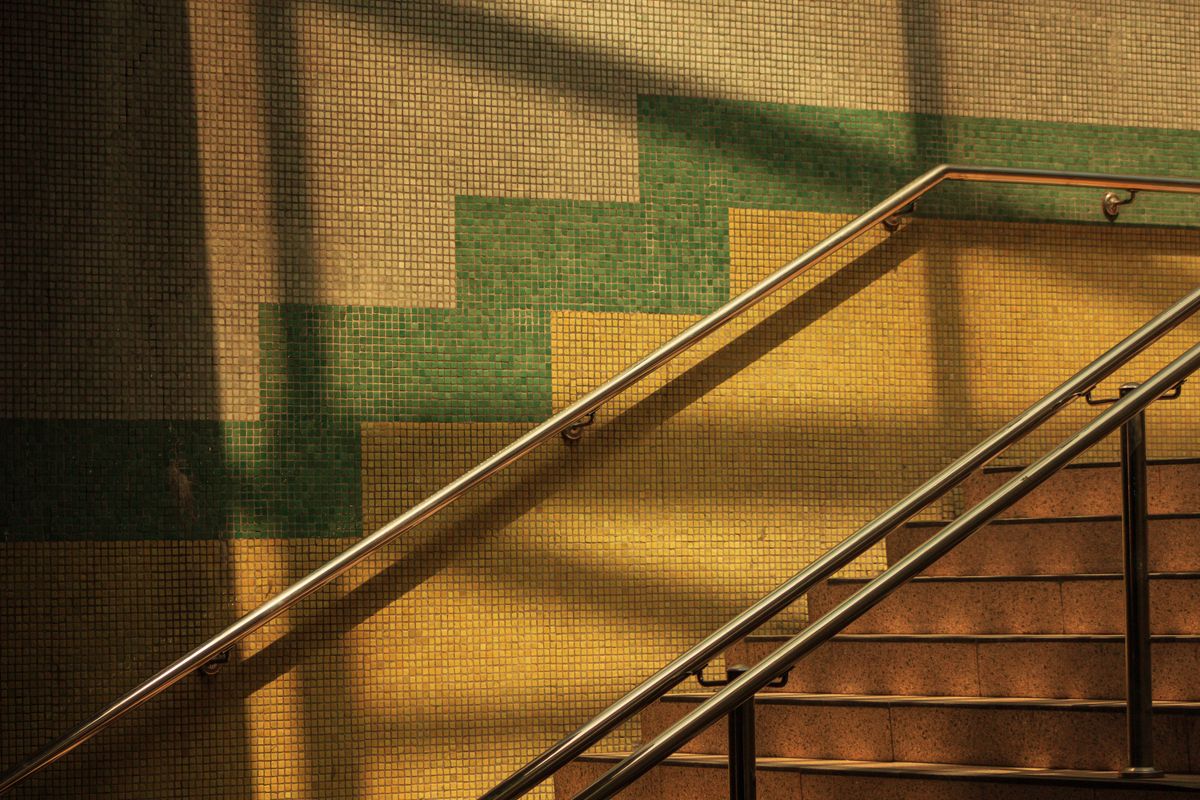
Handrail height sits between 900 and 1,100 mm above the walking surface in most codes. Balustrade guarding height, meanwhile, follows the storey height rules of the local regulation. Moreover, a handrail needs a clear zone behind it. Allow 50–100 mm from the wall, so a knuckle can wrap the section. Our 50 × 30 oval with the wall brackets shown below hits that clearance with a standard 42 mm stand-off. On stairs, an aluminium handrail and balustrade should keep the rail continuous over landings. Also keep the surface free of sharp radius changes. Users slide their palms along it, and every dent becomes a complaint.
Where the Rail Meets the Building
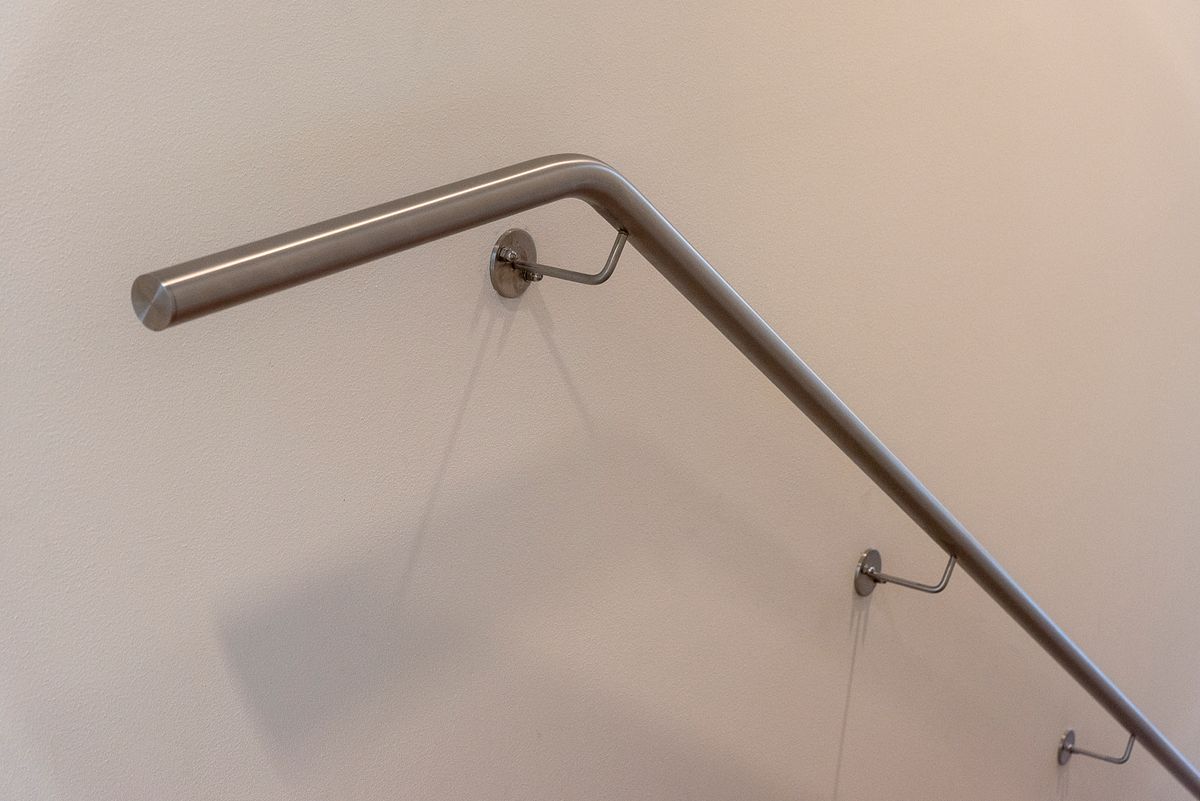
Fixings fail before profiles do, so treat the connection as the real design problem. Surface-mounted base plates suit concrete decks. Core-drilled posts with grout suit stone finishes. Side-mounted brackets suit stair strings and soffits where floor space is tight. Additionally, isolate every aluminium-to-concrete contact with a barrier layer, because wet alkaline concrete attacks bare aluminium over time. A simple EPDM pad or bitumen tape solves it for pennies.
On an aluminium handrail and balustrade fixed to timber or steel substrates, specify stainless bolts with washers large enough to spread the pull-out force. Then check the substrate itself for governing capacity, not the railing. Finally, leave a 3–5 mm gap at thermal movement joints on runs longer than 12 m. Aluminium expands about 2.3 mm per metre over a 40 °C swing, and a run fixed rigid at both ends will bow visibly in summer. On one hotel job in the Gulf, that bow was the only defect found at handover, and it cost a week of rework that a 5 mm slotted hole would have prevented.
Alloy and Temper: 6063-T5 versus 6061-T6
Two alloys cover almost every aluminium handrail and balustrade order we ship. The choice mirrors the logic in our 6063 vs 6061 alloy comparison: 6063 extrudes into crisp shapes with a fine finish, while 6061 carries higher strength for long spans. Temper matters just as much. EN 515 and EN 755-2 define the mechanical values that structural engineers quote back at us.
| Property | 6063-T5 | 6063-T6 | 6061-T6 |
|---|---|---|---|
| Yield strength (EN 755-2) | ≥ 145 MPa | ≥ 170 MPa | ≥ 240 MPa |
| Surface finish after anodising | Excellent | Excellent | Good |
| Complex die shapes | Very good | Good | Limited |
| Typical rail span capability | ≤ 1.5 m | ≤ 1.8 m | ≥ 2.0 m with deep sections |
| Cost index | 1.0 | 1.05 | 1.25–1.35 |
In practice, residential balconies and stairs run happily on 6063-T5 or T6, and we keep both tempers in stock for quick programmes. Public-area projects with 1.0 kN/m line loads and 2 m post spacing usually pull us toward 6061-T6 posts under a 6063 rail. That mix balances strength and appearance without a big price jump. One warning worth repeating. Ask for mill certificates per EN 10204 Type 3.1 on every structural aluminium handrail and balustrade lot, because a batch of unknown stock dressed up as T6 is the most common fake we see in imported fittings.
Interestingly, thermal break technology rarely enters this product family. Profiles per EN 14024, the standard behind our thermally broken window systems, target heat transfer through façades. A handrail has no such duty. However, the same wall-thickness discipline that GB/T 8478-2020 applies to Chinese window and door profiles still shapes how we document an aluminium handrail and balustrade order. Customers who buy both products from one factory expect one quality standard, and they are right to.
Infill Options Compared: Glass, Bars and Cable
The infill panel decides the look, the wind behaviour and a surprising share of the cost. Here is how the three mainstream options trade off in our aluminium handrail and balustrade quotes.
| Infill type | Look | Wind load effect | Weight | Maintenance | Relative cost |
|---|---|---|---|---|---|
| Laminated glass in clamps | Modern, unobstructed | High; posts need upsizing | Heavy | Wash only | High |
| Vertical bars / balusters | Classic, rhythmic | Low; 40–50% open area | Light | Almost none | Medium |
| Horizontal cable / rods | Industrial, minimal | Low | Lightest | Re-tension yearly | Medium-high |
Glass wins where the view is the product, as on hotel terraces and penthouses. However, every glass infill adds point loads at the clamps and raises the wind area, so the post section grows together with the glass. Bars remain the volume workhorse in residential estates. An aluminium handrail and balustrade run with bar infill ships nested, installs fast and never needs adjustment. Cable looks sleek but needs annual re-tensioning, which facilities teams often forget. Therefore we now recommend rods instead of cable wherever a maintenance contract is not guaranteed.
Coatings That Survive the Address
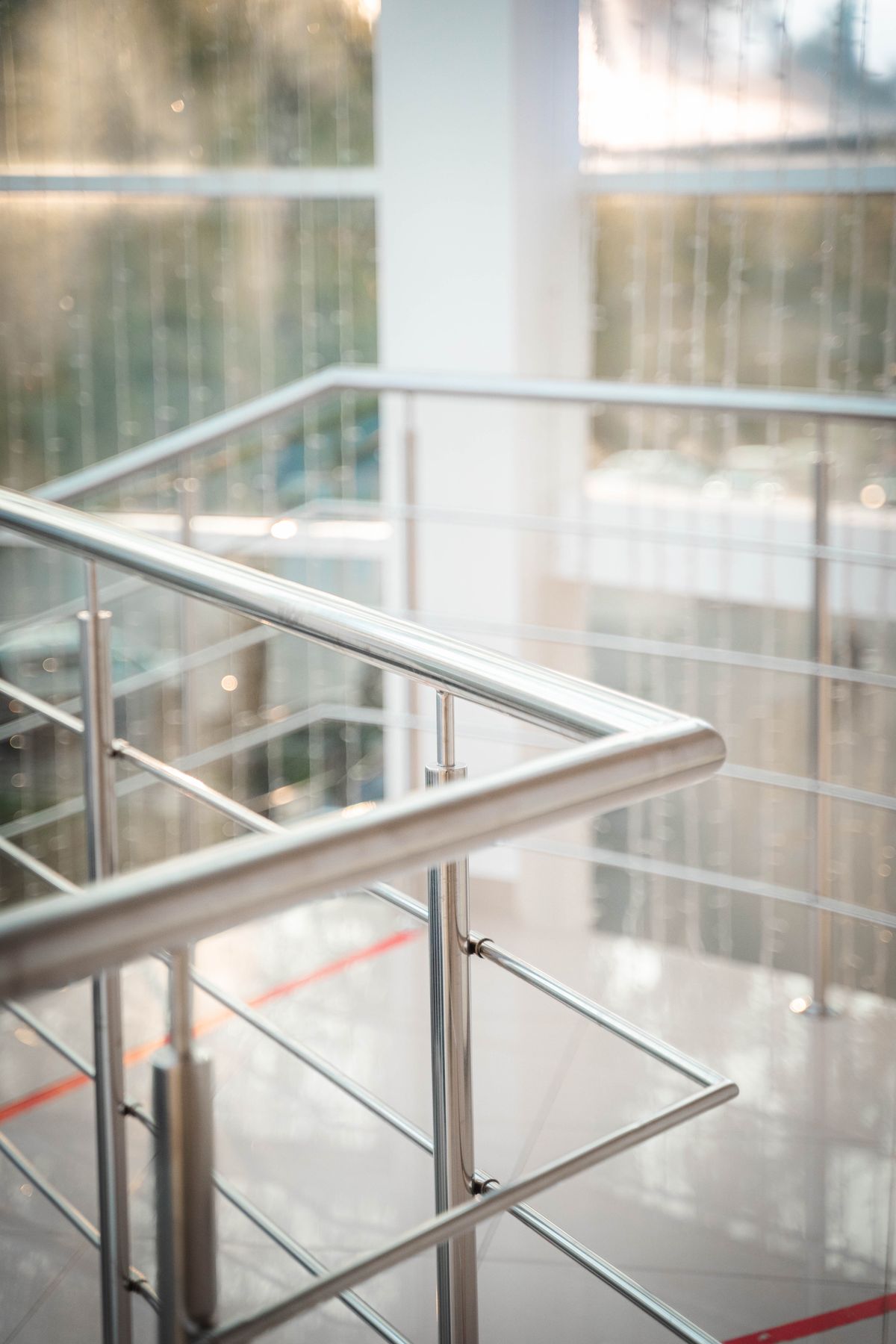
Coating choice for an aluminium handrail and balustrade depends on geography more than on taste. Inland, a Qualicoat-class polyester powder coat at 60–80 μm does the job for decades. Coastal and poolside jobs, however, deserve super-durable polyester per AAMA 2604, or a PVDF system per AAMA 2605, both engineered for salt and UV. Alternatively, anodising to 15–20 μm (AA15/AA20 per Qualanod) gives a metallic depth powder cannot match. It also hides fingerprints on busy stair rails remarkably well.
Whatever the finish on your aluminium handrail and balustrade, the pre-treatment behind it matters more than the topcoat itself. A chromate-free conversion layer, proper rinsing water quality and a controlled oven cure are what separate a coating that passes 1,000-hour salt spray from one that chalks in two summers. Our surface treatment guide walks through the full anodising versus powder coating decision, and we certify coating batches against AAMA or Qualicoat references on request.
Colour, meanwhile, costs almost nothing to change on new tooling. RAL or custom wood-grain sublimation applies at the same line speed, so matching the palette of a curtain wall system is a routine request, not a surcharge story.
Tolerances, QC and the Paperwork Trail
A railing that fails the site survey is the classic import disaster. Posts arrive 2 mm off square. Rails will not nest. Bracket holes miss by a millimetre and a half. We control every aluminium handrail and balustrade batch with EN 755-9 dimensional tolerances on extrusion and EN 12020-2 on machined assemblies, both tighter than what untrained buyers expect. Wall thickness on aluminium handrail and balustrade stock is checked with a micrometer at defined intervals, and our extrusion tolerances guide explains exactly which measurements go on the report.
For an aluminium handrail and balustrade programme, the QC pack typically contains four documents. First, the EN 10204 Type 3.1 mill certificate. Second, the extrusion dimensional report. Third, coating batch certificates. Fourth, a load-test record when the project requires one. ISO 9001 audits keep that chain documented end to end. Ask any prospective supplier for a sample pack before the first container. A factory confident in its process sends one the same week, and ours does exactly that with a 3-day sampling promise.
Three Site Failures We See Most, and How to Prevent Them
After hundreds of programmes, the same three defects keep showing up on competitor-supplied aluminium handrail and balustrade work. The first is post rocking on resin-grouted fixings, caused by skipping the template during drilling. Prevention is boring but cheap: drill through a jig and torque the bolts to a written value. The second is coating chalking on north-facing elevations near the sea, traced back to standard polyester where AAMA 2604 was needed. Prevention is specification discipline, not thicker paint. The third is a rail that bows between fixings in hot weather because the thermal movement gap was never cut. Prevention is the 3–5 mm slotted joint described above, placed every 12 m.
None of these failures involve exotic physics. Yet each one costs weeks of remedial work if it reaches the site, so we build all three preventions into the standard drawing notes of every aluminium handrail and balustrade quotation we send.
Cost Drivers: What Moves the Quote
Buyers often compare handrail quotes across factories and wonder why one is 30% cheaper. Five variables explain nearly all of it. Post spacing comes first in every aluminium handrail and balustrade quote, since fewer posts cut both aluminium volume and installation hours. Infill type comes second, as glass adds panel weight, clamps and careful packing. Third is coating class: AAMA 2605 PVDF carries a premium over standard polyester, justified mainly on coastal sites. Fourth is hardware origin, because stainless clamps and concealed fixings cost more than basic caps but save site rework. Fifth is packing: bundled rails in steel-reinforced crates with EPE interlayers cost slightly more yet keep breakage below 0.2%.
On typical residential volumes, our aluminium handrail and balustrade quotes land in a predictable band once those five variables are fixed. If a rival quote sits far below that band, the shortcut is almost always wall thickness, temper substitution or missing pre-treatment. All three surface as site failures rather than invoice savings. Weight is the fastest sanity check, and our profile weight calculation guide gives you the formula to run before you sign.
From Drawing to Container: How We Run a Rail Programme
Every aluminium handrail and balustrade programme follows a rhythm you can plan around. Drawings arrive, and our engineering team returns extrudable cross-sections within 7 days at no charge. Sampling follows in 3 days for stock dies. After approval, production slots in with 25–35 days to FOB Foshan or Nansha, or CIF and DDP per Incoterms 2020 depending on your preference. Payment runs on T/T 30/70, L/C at sight above USD 20,000, and PayPal covers sample fees. Behind the line, our factory floor pairs the extrusion press with bending, punching and CNC machining under one roof, which is what keeps tolerance drift small between die, coating and assembly; the full workflow is documented in our aluminium extrusion process guide.
The same press park serves every product family we make, so a handrail programme benefits directly from that shared discipline. Volume buyers add one more advantage: shared tooling across estates. When a developer repeats a rail design across phases, the die already exists, the coating recipe is proven, and the second order often runs 15–20 days shorter than the first. In short, an aluminium handrail and balustrade supply chain rewards buyers who commit to one section across a portfolio, not just across one building.
Frequently Asked Questions
1. What line load must a balcony handrail resist?
Under EN 1991-1-1, residential (Category A) areas take 0.5 kN/m on the top rail of an aluminium handrail and balustrade, while public areas reach 1.0 kN/m or higher. Industrial guardrails per ISO 14122-3 take 1.0 kN/m plus infill loads. Always confirm with the local authority’s table, since national annexes modify the base values.
2. Which alloy should I choose, 6063-T5, 6063-T6 or 6061-T6?
For spans up to 1.5 m, 6063-T5 delivers the best finish at the lowest cost. Long spans above 1.8 m or heavy public loads justify 6061-T6 posts. Mixed assemblies, a 6063 rail on 6061 posts, are our most common specification on hospitality aluminium handrail and balustrade projects.
3. How do you prevent corrosion near the sea?
Specify super-durable polyester per AAMA 2604 or PVDF per AAMA 2605, or anodise to AA15/AA20. Add EPDM isolation at every concrete or steel contact point of the aluminium handrail and balustrade, and schedule two washes a year. With that combination, our coastal installations in Southeast Asia have held colour and adhesion for a decade.
4. Can you match our existing RAL colour or a wood-grain finish?
Yes. Powder coating runs any RAL on aluminium handrail and balustrade stock at the same line speed, and sublimation wood-grain finishes apply to stock profiles without new tooling. Send the colour code with the drawing and we return a coated sample for approval before batch coating.
5. What is your MOQ for handrail and balustrade profiles?
Stock aluminium handrail and balustrade sections ship from 100 metres. Custom dies amortise over the first 200–400 metres, so a bespoke rail becomes viable around that volume. Mixed programmes, several profile types in one container, are welcome and common.
6. Which payment terms do you accept?
T/T with 30% deposit and 70% before shipment is standard. L/C at sight is available above USD 20,000 order value, and PayPal covers sample and tooling deposits. All three fit routine export workflows with our compliance team.
7. How is an aluminium handrail and balustrade order packed and shipped?
Rails and bars ship nested in bundles, posts crated separately, with EPE foam interlayers inside steel-reinforced wooden crates; breakage stays below 0.2%. Shipping terms run FOB Foshan or Nansha, CIF or DDP per Incoterms 2020, and lead time after approval is 25–35 days depending on the coating queue.
8. Do you provide load-test evidence or engineering support?
Yes. We supply EN 10204 Type 3.1 mill certificates as standard, and project-specific load calculations or third-party test records on request. Send us the span and the applicable line load, and our engineers confirm the section before you commit to the die.
Bring the Layout, Get the Numbers
An aluminium handrail and balustrade system rewards early engineering more than late decoration. Fix the load case, pick the alloy by span, match the coating to the address, and the rest of the decisions become simple. Our factory runs 6 production lines and over 500 profiles per day at ±0.5 mm tolerance, certified to ISO 9001, and our team will return a load-checked section proposal with a quote. Send us your drawings today for a free extrudable design review, or request a free sample pack and see the finish quality in your own hands.
CONTACT US


Foshan Naview New Building Materials Co., Ltd.
We are always here offering customers our reliable products and service.
If you want to liaise with us now, please click contact us