
Aluminum Profile Surface Treatment: How to Choose Between Anodizing, Powder Coating, PVDF, and Electrophoresis
- By:Naview
- Date:2026-07-23
–>
By the Naview Aluminium Engineering Team | Updated July 2026
I’ve lost count of how many RFQs land on my desk with “surface treatment: as per standard” written in the spec column. However, there’s no such thing as a standard surface treatment for aluminum profiles. Anodizing that works beautifully on a window frame in London will look dead in six months on a curtain wall in Jeddah. Likewise, powder coating that survives a decade in Singapore will chalk in two years on a Dubai high-rise.
The finish you pick doesn’t just change how the profile looks. Instead, it determines the coating’s lifespan, corrosion resistance, maintenance cost, and whether your project passes inspection or becomes warranty liability. At Naview, we run our own in-house anodizing line and work with certified coating partners for powder, PVDF, and electrophoretic finishes. Over 20 years of supplying aluminum profiles to 30+ countries, we’ve watched the same specification mistakes repeat across projects.
This article covers the four main aluminum profile surface treatment methods side by side — what they actually do, where they fail, and which one makes sense for your application. No marketing gloss. Just the engineering data and field experience you need to write a spec that holds up.
How Anodizing Works on Aluminum Profiles — and Where It Doesn’t
The Electrochemical Process
Anodizing isn’t a coating. That’s the first thing worth understanding. Rather than spraying or dipping something onto the aluminum surface, anodizing is an electrochemical process that grows a controlled oxide layer from the aluminum itself. First, the profile goes into an acid bath — usually sulfuric acid. Then current passes through. Finally, oxygen ions react with the aluminum to form aluminum oxide (Al₂O₃). This layer is fully integrated with the base metal; it doesn’t sit on top like paint.
The result is a surface roughly twice as hard as powder coating and significantly more scratch-resistant. Moreover, an anodized aluminum profile with a 15-micron film thickness easily handles interior architectural applications. For exterior use, we recommend 20-25 microns (AA20-AA25 grade under ISO 7599).
Color and Defect Limitations
However, anodizing has real limitations. The color palette is narrow — silver, champagne, bronze, black, and a few metallic variants. You cannot match RAL or Pantone colors with anodizing alone. Furthermore, the process reveals surface defects rather than hiding them. If the aluminum billet has grain structure variation, the anodized finish will show it. Similarly, die lines, weld seams, and extrusion marks become more visible after anodizing, not less.
When to Specify Anodizing
Best suited for: Interior door and window profiles, architectural frames where metallic finish matters, indoor decorative trims, and electronics enclosures. Also viable for exterior applications in mild climates with at least AA20 film thickness.
Not recommended for: Coastal environments with salt spray exposure beyond 500m from shoreline, industrial zones with high SO₂ concentration, and any project requiring bold, non-metallic colors.
MOQ: No minimum — every Naview profile can be anodized in-line. Lead time: Add 3-5 days to base extrusion schedule. Cost: $1.50–$3.00/m² depending on film thickness and color.
Powder Coating Aluminum: The Workhorse Finish for 90% of Projects
How the Coating Forms
If you need aluminum profiles in a specific color — and especially if that color must match a corporate brand guide — powder coating is almost certainly your answer. The process applies dry polymer powder electrostatically to the aluminum surface, then cures it in an oven at 180-200°C. During curing, the powder melts, flows, and cross-links into a continuous film, typically 60-80 microns thick.
Unlike anodizing, powder coating hides surface irregularities. It fills minor scratches, die lines, and handling marks, producing a uniform appearance even on profiles with complex cross-sections. In addition, the RAL color range is essentially unlimited. We’ve matched everything from standard RAL 9016 traffic white to custom metallics with sparkle effects.
Performance Grades Matter
The performance range in powder coating is wider than most buyers realize. Standard polyester powder (Qualicoat Class 1) delivers 10-15 years of exterior durability in moderate climates. Meanwhile, super-durable polyester (Qualicoat Class 2) extends that to 15-25 years. For the harshest conditions, fluoropolymer-modified powders approach PVDF performance at roughly 60% of the cost.
Yet here’s the catch: if your spec sheet just says “powder coated,” the supplier will default to the cheapest Class 1. Consequently, that becomes the single most common source of premature coating failure we see in claims.
Corner Coverage Reality
One practical note: powder coating corner coverage is never perfect. On profiles with deep grooves, tight recesses, or sharp internal angles, the electrostatic spray pattern doesn’t reach uniformly. Therefore, the aluminum in those areas will have thinner film — sometimes below 40 microns when the face is at 80. For structural profiles with hidden fastener channels, this usually doesn’t matter. For visible decorative profiles, it’s worth asking your supplier for a cross-section sample before signing off on production.
Best suited for: Exterior door and window frames, curtain wall mullions, decorative trims, railing systems, and any project requiring specific RAL colors or textured finishes.
MOQ: 500 kg per color for standard RAL; 2,000 kg for custom matching. Lead time: Add 5-7 working days. Cost: $3.00–$6.00/m² depending on powder grade and color complexity.
PVDF Coating: When the Building Has to Look the Same in 20 Years
The Chemistry Behind the Durability
PVDF (polyvinylidene fluoride) coating is the premium option in aluminum profile surface treatment. It’s also the only choice when architectural specifications demand warranty-backed color retention over decades. The coating system typically consists of a chrome-based pretreatment layer, a primer coat, a color coat containing 70% PVDF resin (Kynar 500® or Hylar 5000® grade), and in some cases a clear topcoat. Total dry film thickness runs 25-35 microns for a 2-coat system and 35-45 microns for 3-coat.
What makes PVDF fundamentally different from powder coating is the carbon-fluorine bond in the polymer backbone. This bond is among the strongest in organic chemistry (bond energy approximately 485 kJ/mol). As a result, UV radiation, acid rain, and salt spray cannot break this bond easily. That’s why PVDF-coated aluminum curtain wall panels on buildings in Singapore, Dubai, and Miami still look new after 15-20 years, while adjacent powder-coated elements show visible chalking and color shift within 5-8 years.
Cost and Logistics
The trade-off is cost and lead time. PVDF coating requires a liquid spray line with controlled temperature and humidity, multi-stage curing, and strict quality control on film thickness measurement. Not every extrusion factory runs PVDF in-house; most outsource to specialized coating facilities, adding logistics and coordination. At Naview, we manage the full PVDF coating workflow through our certified partner network, baking the coordination into the production schedule so the customer deals with one point of contact.
Best suited for: High-rise curtain wall profiles, monumental architecture, coastal and high-UV environments, and any project with a 20+ year design life where recladding costs exceed the finish premium.
MOQ: 1,000 kg per color. Lead time: Add 10-14 working days. Cost: $8.00–$15.00/m² depending on color and coat count.
Electrophoretic Coating: The Underrated Middle Ground
How E-Coat Differs from Spray Finishes
Electrophoretic coating (E-coat, or ED coating) occupies an interesting niche between anodizing and powder coating. First, the process anodizes the aluminum profile to create a porous oxide layer. Then it immerses the profile in a water-based electrophoretic paint bath. An electric field deposits charged resin particles uniformly across the surface, including deep into grooves and recesses that spraying methods struggle to reach. Finally, a bake cross-links the resin into a smooth, glossy film — typically 15-25 microns thick on top of the anodized substrate.
The standout advantage of electrophoresis over powder coating is dead-corner coverage. If you’ve ever looked closely at the bottom of a T-slot groove on a powder-coated profile and noticed the metal showing through, you’ve seen the limitation of electrostatic spray. E-coat doesn’t have this problem because the electrical field pulls coating particles into every recess equally. For profiles with intricate cross-sections, louver blades, or decorative patterns, electrophoresis delivers coverage quality that spraying simply cannot match.
Aesthetic and Performance Profile
The finish aesthetic leans toward the glossy-transparent or lightly tinted spectrum — silver, champagne, light bronze, and black are common. The coating bonds with the anodized layer underneath, creating a composite protection system: the anodic oxide provides hardness and UV resistance, while the electrophoretic film adds chemical resistance and scratch protection. Service life in exterior applications typically reaches 15-20 years, comparable to super-durable powder coating.
Still, there are downsides. Color selection is limited compared to powder. Dark electrophoretic colors tend to show heat-checking under extreme thermal cycling. Moreover, the process is less widely available than powder coating. For high-end architectural doors and windows — especially sliding systems where the track grooves must be fully sealed against moisture — electrophoresis often outperforms alternatives at a lower cost than PVDF.
Best suited for: Premium sliding windows and doors, louver systems, profiles with complex grooves or recesses, and high-humidity environments where full-coverage corrosion resistance matters.
MOQ: 800 kg per color. Lead time: Add 7-10 working days. Cost: $4.00–$7.00/m².
Surface Treatment Comparison: Data Table
| Property | Anodizing | Powder Coating | PVDF Coating | Electrophoresis |
|---|---|---|---|---|
| Film Thickness | 10–25 μm | 60–80 μm | 25–45 μm | 15–25 μm (+ anodized base) |
| Surface Hardness | 250–350 HV | 80–120 HV | 70–100 HV | 200–280 HV |
| Color Range | Limited (metallic tones only) | Unlimited (RAL/Pantone) | Wide (solid + metallic) | Limited (transparent tints) |
| UV Resistance | Excellent (no organic binder to degrade) | Good to Very Good (grade-dependent) | Outstanding (20+ year warranty available) | Very Good |
| Salt Spray Resistance | Good (AA20+) | Good (Qualicoat Class 2+) | Excellent | Very Good |
| Corner/Groove Coverage | Uniform | Moderate to Poor | Good | Excellent |
| Chemical Resistance | Poor (attacked by alkali) | Good | Excellent | Very Good |
| Typical Service Life (Exterior) | 15–25 years (climate-dependent) | 10–25 years (grade-dependent) | 20–30 years | 15–20 years |
| Relative Cost | $ | $$ | $$$$ | $$$ |
| Environmental | Acid bath disposal required | Zero VOC, overspray recyclable | Solvent-based, VOC controlled | Water-based, low VOC |
Data based on Naview in-house testing and third-party lab reports. Actual performance varies by alloy grade, pretreatment quality, and installation environment.
How to Pick the Right Surface Treatment: A Decision Framework
After two decades of answering “which finish should I use?” from project buyers, contractors, and architects, we’ve boiled the decision down to four questions. Answer these in order, and the right choice usually reveals itself.
Question 1: What’s the project’s design life for the visible finish?
If you need the aluminum to look the same in 5-10 years and budget is tight, standard powder coating does the job. If the specification requires 15-20 years with no visible degradation, choose super-durable powder or electrophoresis. If the architecture demands 25+ years of color-fast performance, PVDF is the only defensible answer. Moreover, the price premium almost always costs less than recladding once over the building’s life cycle.
Question 2: Where is the building located?
Coastal within 1 km of salt water? Eliminate standard powder coating immediately. High-UV arid climate like the Gulf? Choose anodizing with AA25 thickness or PVDF. Industrial zone with SO₂ or NOₓ emissions? Eliminate anodizing — the alkali in atmospheric pollution attacks aluminum oxide. High-humidity tropical? Electrophoresis often outperforms all alternatives on cost-versus-durability at 15-20 years.
Question 3: What color does the architect want?
Metallic silver/champagne/bronze with a natural metal look: anodizing or electrophoresis. Specific RAL 7016 anthracite grey, RAL 9005 jet black, or brand-mandated custom color: powder coating or PVDF. High-gloss mirror finish: electrophoresis on a polished substrate.
Question 4: How complex is the profile cross-section?
Simple rectangular or flat profiles: any treatment works. Profiles with deep T-slots, narrow grooves, internal channels, or decorative cutouts: electrophoresis for full coverage, or powder coating with the understanding that recessed areas will have thinner film. PVDF liquid spray also handles complex geometries reasonably well.
From Our Factory Floor: What Naview Brings to Surface Treatment
Surface treatment isn’t just about the chemistry. It’s also about the pretreatment before the coating and the quality control after it. A $50/m² PVDF coating on poorly pretreated aluminum fails faster than a $3/m² powder coat on properly etched and chromated substrate.
At Naview, our 600,000-square-meter factory in Foshan runs the full pretreatment chain in-house: degreasing, alkaline etching, acid neutralization, and chrome-free conversion coating. All stages are automated and monitored by conductivity and pH sensors in real time. Our anodizing line handles profiles up to 7.2 meters with ±1 micron film thickness control. For powder and PVDF, we work with Qualicoat and AAMA-certified coating partners who color-match across production batches and provide 10-year accelerated weathering data as standard.
Key numbers buyers ask about:
- 6 extrusion lines, 500+ profiles per day output, ±0.5mm precision
- ISO 9001 certified process control from billet receipt to finished profile inspection
- 30+ countries exported, with surface treatment spec experience across Middle East (SABER/GCC), Europe (CE/UKCA), Africa, and Southeast Asia
- 7-day design review, 3-day sampling, free samples for qualified projects
- MOQ flexible — as low as 500 kg per profile design for trial orders
If you’re specifying profiles for a project and want to validate which surface treatment holds up in your climate, send us your spec. We’ll come back with a recommendation, data sheet, and free coated sample within a week. → Request a free surface treatment sample
Internal Link Suggestions
- Aluminum Door and Window Profiles: Complete Engineering Guide — anchor text: “aluminum door and window profiles”
- Aluminum Profile Products — anchor text: “Naview aluminum extrusion profiles”
- Industrial Aluminum Profiles Guide — anchor text: “industrial aluminum profile selection”
- Quality Control & Certifications — anchor text: “ISO 9001 certified extrusion process”
- Contact NA-VIEW — anchor text: “free surface treatment sample”
External Link Suggestions
- Qualicoat Specifications for Architectural Powder Coating — https://www.qualicoat.net/ — anchor text: “Qualicoat architectural coating standards”
- AAMA 2605 Standard for High-Performance Organic Coatings — https://www.aamanet.org/ — anchor text: “AAMA 2605 PVDF coating specification”
- ISO 7599 Anodizing Specification — https://www.iso.org/standard/ — anchor text: “ISO 7599 anodizing film thickness grades”
Image Suggestions
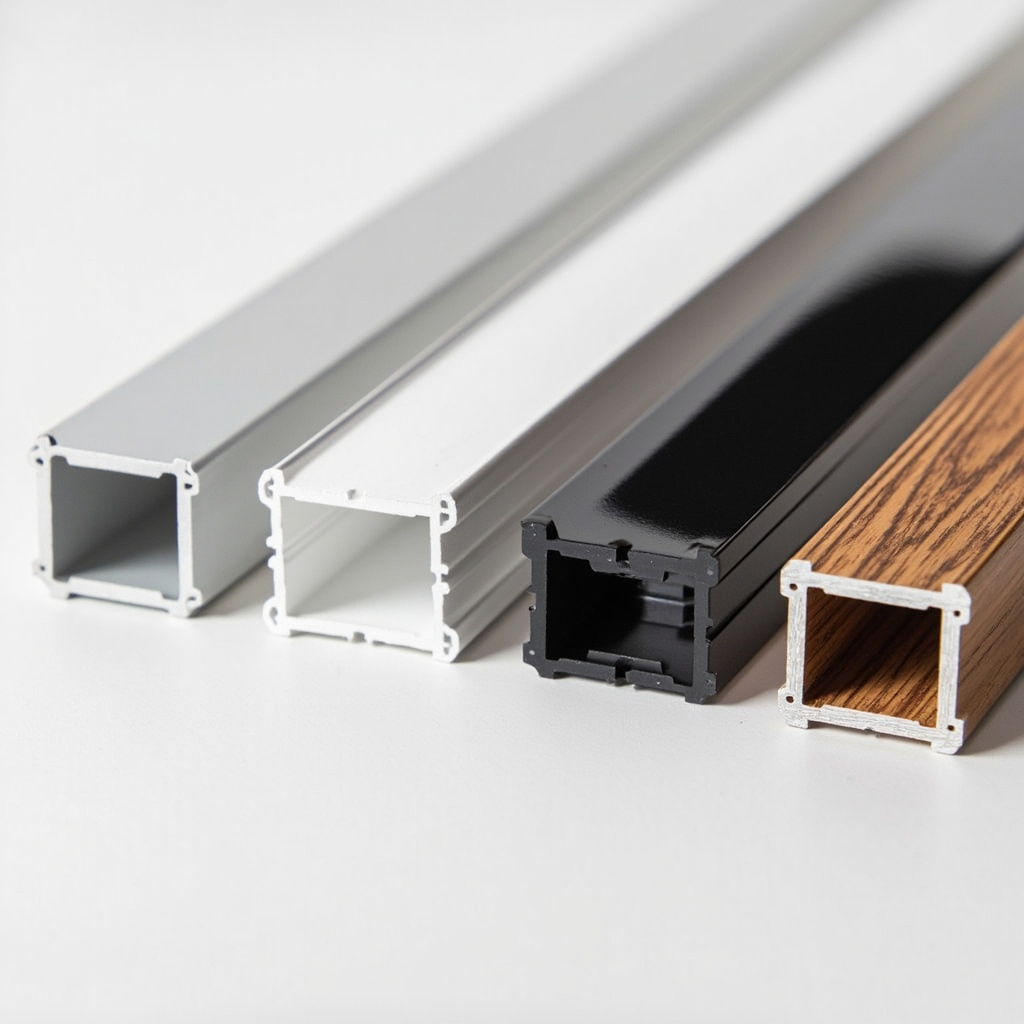
- After Introduction — Product comparison photo showing four aluminum profile samples side by side (anodized, powder coated, PVDF, electrophoretic) — aluminum-profile-surface-treatment-comparison-samples.jpg — alt: “Four aluminum profile surface treatment samples: anodized, powder coated, PVDF, and electrophoretic finishes”
- After Anodizing Section — Close-up macro photo of anodized aluminum surface showing metallic grain — anodized-aluminum-profile-surface-texture.jpg — alt: “Anodized aluminum profile surface treatment with metallic champagne finish”
- After Powder Coating Section — Factory photo of powder coating spray booth with aluminum profiles on conveyor — powder-coating-aluminum-profile-production-line.jpg — alt: “Aluminum profile surface treatment by electrostatic powder coating on production line”
- After Data Table — Infographic comparing UV resistance and corrosion performance of four surface treatments — aluminum-surface-treatment-performance-comparison-chart.jpg — alt: “Performance comparison chart for aluminum profile surface treatment methods”
- After Brand Section — Factory exterior or quality control lab photo — naview-aluminum-profile-quality-inspection.jpg — alt: “Quality inspection of aluminum profile surface treatment at NA-VIEW factory”
Frequently Asked Questions
What is the most durable surface treatment for aluminum profiles?
PVDF coating offers the highest durability for exterior applications, with 20-30 year service life and best-in-class UV and chemical resistance. For abrasion resistance specifically, hard anodizing (Type III, 50+ microns) outperforms all other treatments, reaching 350-500 HV surface hardness.
Can powder coated aluminum profiles be used in coastal areas?
Yes, but only with the right powder grade. Standard polyester powder will chalk and corrode within 3-5 years in salt spray environments. Therefore, super-durable polyester (Qualicoat Class 2) or fluoropolymer-modified powder is required for applications within 1 km of coastline. Ask your supplier for AAMA 2604 or AAMA 2605 certification.
What is the cost difference between anodizing and powder coating?
Anodizing costs approximately $1.50–$3.00/m², while standard powder coating runs $3.00–$6.00/m². However, anodizing has narrower color options and reveals surface defects. Powder coating provides better hiding power and unlimited color choice for the price premium. The total project cost difference typically ranges from 5-15% depending on color requirements.
How long does PVDF coating last on aluminum curtain wall profiles?
A properly applied 3-coat PVDF system with 70% Kynar 500 resin lasts 20-30 years with minimal color change (ΔE ≤ 5 after 20 years in most climates). Manufacturers routinely warranty PVDF finishes for 15-20 years against chalking and fading when applied to AAMA 2605 specification.
Does electrophoresis provide better corrosion resistance than anodizing?
Yes, because electrophoresis creates a composite protection system: the anodized oxide layer blocks oxidation while the electrophoretic film seals the porous oxide and adds chemical resistance. In salt spray testing (ASTM B117), electrophoretic profiles typically outperform standalone anodizing by 300-500 hours before first corrosion signs appear.
Get a Free Surface Treatment Recommendation for Your Project
Tell us your project location, exposure conditions, color requirements, and budget range. Our engineering team will recommend the most cost-effective surface treatment, provide coated sample swatches, and deliver a production timeline — typically within 24 hours. Request a free consultation now →
CONTACT US

Foshan Naview New Building Materials Co., Ltd.
We are always here offering customers our reliable products and service.
If you want to liaise with us now, please click contact us