

Aluminum Door & Window Profiles: Full Guide
- By:Naview
- Date:2026-07-21
By the Naview Aluminium Technical Team | Updated July 2026
After 20 years of extruding aluminum door and window profiles, the question we hear most often is simple: “We’re making windows and doors — which profile do we actually need?”
It sounds straightforward, yet it breaks into at least five decisions: alloy grade, wall thickness, thermal break or not, surface finish, and opening type. For instance, get one wrong and you end up with failed energy codes, hardware that doesn’t fit, or callbacks from the job site.
Therefore, what follows is what we’ve learned from real orders, real factory-floor problems, and real feedback from fabricators and contractors. No fluff.
Table of Contents
- What Are Aluminum Door and Window Profiles?
- Alloy Grades: 6063 vs 6061 vs 6060
- Thermal Break vs Non-Thermal Break: Not Just Price
- Profile Series Explained (55, 60, 70, 80, 90)
- Wall Thickness — Where Suppliers Cut Corners
- Thermal Break Strips: PA66 vs PVC
- Surface Treatment Options
- Opening Types and Sealing Performance
- 5-Step Profile Selection Framework
- Standards and Certifications
- Frequently Asked Questions
1. What Are Aluminum Door and Window Profiles?
Aluminum door and window profiles are extruded cross-sections made from Al-Mg-Si alloys, mostly the 6000 series. In other words, they form the skeleton of the window or door: the frame, sash, mullions, and glazing beads that hold the glass, hardware, and weather seals.
Because the cross-section design controls almost every performance metric — thermal insulation, sound reduction, wind load resistance, water tightness, and hardware compatibility — two windows can look identical from the outside yet perform completely differently underneath.
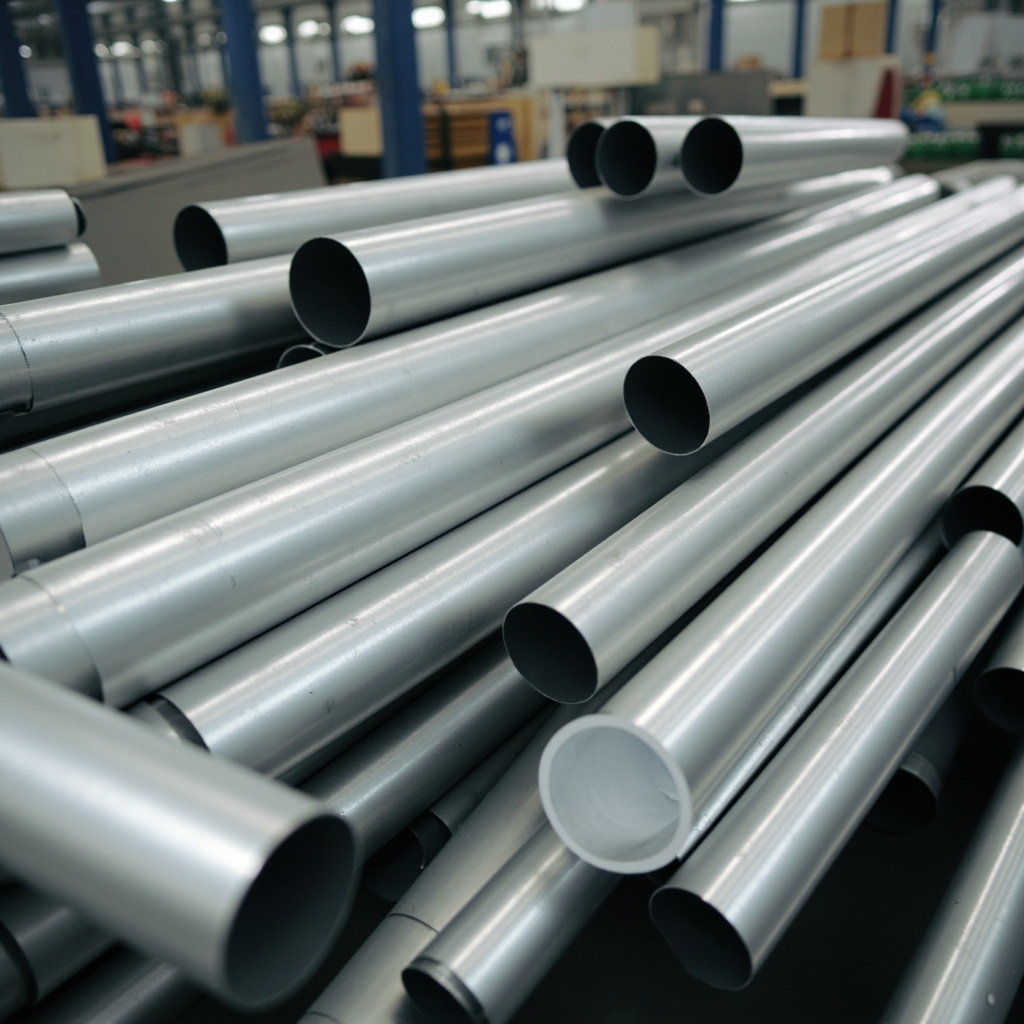
Aluminum holds over 65% of the global commercial window and door market for solid reasons:
- Strength-to-weight ratio: Aluminum gives you steel-like structural performance at roughly one-third of the weight. Consequently, fabricators can design larger glass areas and slimmer sightlines.
- Corrosion resistance: The natural oxide layer protects against rust — a big advantage over steel in coastal and humid environments.
- Extrudability: Aluminum can be extruded into complex hollow shapes with internal chambers, gasket grooves, and hardware slots that other materials simply cannot form.
- Recyclability: Aluminum profiles can be recycled indefinitely without losing properties. Therefore, they matter for green building certification.
- Finish versatility: Powder coating, anodizing, and wood grain transfer offer hundreds of color options with 20–30 year outdoor durability.
For a deeper technical overview of aluminum extrusion, Wikipedia’s aluminum extrusion entry covers the process well.
2. Alloy Grades: 6063 vs 6061 vs 6060
Alloy composition directly affects extrudability, strength, corrosion resistance, and surface finish quality. Below is how the common grades compare for aluminum door and window profiles.
| Alloy Grade | Composition | Tensile Strength | Key Properties | Best For |
|---|---|---|---|---|
| 6063-T5 | Al-Mg-Si (Mg 0.45–0.9%, Si 0.2–0.6%) | ≥ 157 MPa | Excellent extrudability, good corrosion resistance, superior anodizing response, smooth surface | The industry default — over 90% of aluminum door and window profiles worldwide. Casement windows, sliding doors, residential and commercial fenestration. |
| 6063-T6 | Same composition, higher temper | ≥ 215 MPa | Higher strength than T5, slightly lower extrudability | Large-span windows, high wind-pressure zones, heavy-duty sliding doors |
| 6061-T6 | Al-Mg-Si-Cu (adds Cu) | ≥ 260 MPa | Higher strength, good weldability, rougher surface finish, harder to extrude | Structural applications, curtain wall mullions, oversized commercial entrances |
| 6060-T66 | Al-Mg-Si (lower alloy content) | ≥ 190 MPa | Excellent extrudability for complex thin-wall sections, European standard for precision profiles | High-end European window systems, slim-line profiles, thermally broken systems |
Our practical recommendation: For 90% of window and door projects, use 6063-T5. In our experience, it balances strength, extrudability, cost, and surface finish better than anything else. Move to 6061-T6 only when you need structural-grade strength, and 6060-T66 only for European precision systems with thin-wall extrusions.
Factory reality: 6063-T5 accounts for more than 95% of our aluminum door and window profile orders. In contrast, the other alloys are not bad — they are simply unnecessary for most jobs.
You can compare the full alloy specifications on the Aluminum Association website.
3. Thermal Break vs Non-Thermal Break: Not Just Price
Aluminum conducts heat at roughly 200 W/m·K. By contrast, PA66 GF25 thermal break strip conducts at about 0.30 W/m·K — a difference of roughly 700 times.
Non-thermal-break profiles are a single piece of aluminum. As a result, heat travels straight through the frame from outside to inside. In winter, therefore, the interior frame surface is cold. Thermal break profiles split the aluminum into inner and outer sections, connecting them with a low-conductivity polyamide strip. Because of this, heat transfer drops dramatically.
Non-Thermal-Break Profiles
- Wall thickness: typically 1.2–1.4 mm
- Frame U-value (Uf): 5.0–7.0 W/m²K
- Suitable for: interior partitions, mild climates, budget-constrained projects, temporary structures
- Not suitable for: exterior windows in cold climates, energy-code-compliant buildings, condensation-sensitive environments
Thermal Break Profiles
- Wall thickness: 1.4–2.0 mm (GB/T 8478-2020 requires ≥1.8 mm for exterior window load-bearing sections)
- Frame U-value (Uf): 1.8–3.2 W/m²K depending on PA66 strip width
- Condensation: interior frame surface stays within 2–3°C of room temperature
- Sound reduction: PA66 dampens vibration, adding 2–5 dB compared with non-thermal-break profiles
- Suitable for: all exterior windows and doors with temperature variation, energy-code-compliant buildings
System Window Profiles
System profiles are engineered as a complete solution — extrusion, thermal break, hardware, seals, and glazing are designed and tested together. In other words, the supplier warrants whole-window performance, not just the profile.
- Wall thickness: 1.6–2.2 mm
- Frame U-value (Uf): 2.0–2.5 W/m²K (system-tested)
- Suitable for: high-end residential, villas, commercial buildings requiring certified whole-window performance
| Metric | Non-Thermal Break | Thermal Break | System Window |
|---|---|---|---|
| Frame Uf value | 5.0–7.0 W/m²K | 1.8–3.2 W/m²K | 2.0–2.5 W/m²K |
| Condensation risk | High | Low | Very low |
| Sound reduction (frame) | Minimal | +2–5 dB | +3–7 dB |
| Energy code compliance | Fails most modern codes | Meets ASHRAE, EN standards | Exceeds most codes |
| Relative cost | Lowest | Moderate | Highest |
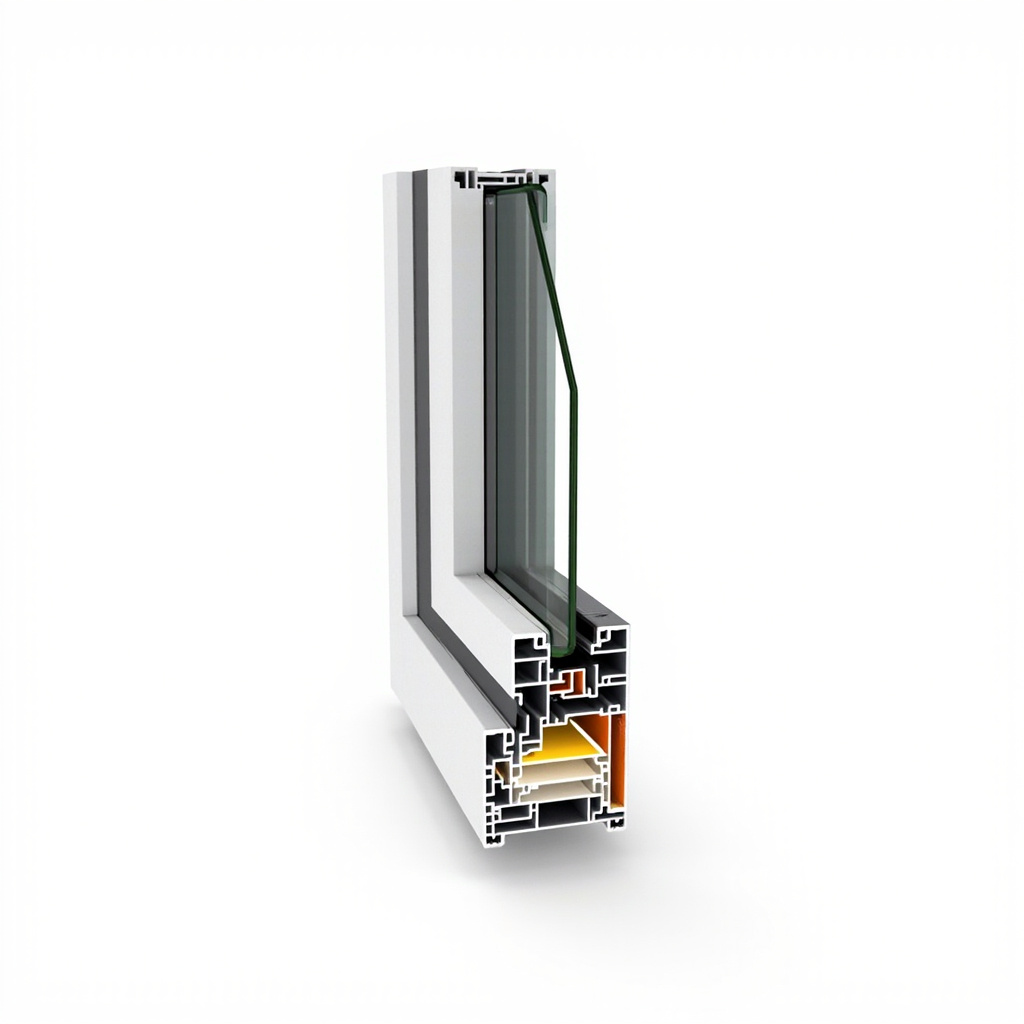
Read more about thermal bridging and why it matters in building envelopes on the U.S. Department of Energy building envelope guide.
4. Profile Series Explained (55, 60, 70, 80, 90)
The series number is the cross-section width of the profile in millimetres. For example, a 70-series profile has a 70 mm frame depth. This number tells you how much internal space is available for thermal breaks, chambers, glass units, and hardware.
| Series | Frame Width | Recommended Wall Thickness | PA66 Strip Width | Typical Glass Config | Best Application |
|---|---|---|---|---|---|
| 55 | 55 mm | 1.4 mm | 12–14 mm | 5+12A+5 double | Low-rise, mild climate, budget projects |
| 60 | 60 mm | 1.4 mm | 14–18 mm | 5+12A+5 or 5+20A+5 | Standard residential, mid-rise apartments |
| 70 | 70 mm | 1.4–1.8 mm | 20–24 mm | 5+22A+5 or triple glazing | Most homes — bedrooms, living rooms, mid-to-high rise |
| 80 | 80 mm | 1.6–2.0 mm | 24–32 mm | Triple glazing or laminated insulating | High-rise (20+ floors), cold climates, large windows, roadside noise |
| 90+ | 90 mm+ | ≥2.0 mm | 28–34 mm | Triple + laminated composite | Ultra-high-rise, typhoon zones, Passive House, luxury villas |
A common trap: series number alone does not guarantee performance. We have seen 80-series profiles with 1.4 mm walls and PVC insulation strips perform worse than a properly built 70-series with 1.8 mm walls and PA66 thermal breaks. Therefore, always verify the combination of series, wall thickness, strip material, and strip width together.
5. Wall Thickness — Where Suppliers Cut Corners
Wall thickness is the single most important structural specification for aluminum door and window profiles. Indeed, it directly affects wind pressure resistance, structural integrity, and safety — especially in high-rise buildings where window failure can be catastrophic.
China’s national standard GB/T 8478-2020 sets the following minimums:
| Application | Minimum Wall Thickness | Recommended for High-Rise |
|---|---|---|
| Interior doors | ≥ 1.4 mm | 1.4 mm |
| Interior windows | ≥ 1.4 mm | 1.4 mm |
| Exterior windows (main load-bearing) | ≥ 1.8 mm | 1.8–2.0 mm |
| Exterior doors (main load-bearing) | ≥ 2.0 mm | 2.0–2.2 mm |
| Heavy-duty sliding doors | ≥ 2.0 mm | 2.0–3.0 mm |
Additional thickness considerations:
- Single pane area > 3–4 m²: increase wall thickness or add intermediate mullions.
- Buildings above 20 floors: we recommend ≥2.0 mm regardless of profile series, due to higher wind loads.
- Coastal and typhoon-prone areas: profiles should be tested for the wind pressure class required by local codes.
Receiving inspection tip: measure wall thickness at the main load-bearing sections — the vertical stiles and horizontal rails of the sash — with a caliper. Do not measure the glazing bead or auxiliary sections. Some suppliers meet the spec only at non-critical points. Unfortunately, we have seen this more than once.
The GB/T 8478-2020 standard is published by the Standardization Administration of China (note: public link varies; verify with your local standards body).
6. Thermal Break Strips: PA66 vs PVC
The thermal break strip is the heart of a thermally broken profile. Use the right material and the window insulates for 25 years. Conversely, use the wrong one and the profile delaminates after a few thermal cycles.
Why PA66 GF25
PA66 GF25 is polyamide 66 with 25% glass fibre. The glass fibre is not just for strength — it brings the coefficient of thermal expansion close to aluminum’s.
- Aluminum CTE: about 23 × 10⁻⁶/K
- PA66 GF25 CTE: about 25 × 10⁻⁶/K
Because the two materials expand and contract at almost the same rate, the composite stays bonded through summer heat and winter cold. If the expansion rates do not match, the strip and aluminum separate — consequently, the thermal break becomes no break at all.
PA66 vs PVC: Simple Field Tests
- Burn test: hold a lighter to a small strip. PA66 self-extinguishes when the flame is removed and smells like burning hair. Meanwhile, PVC keeps burning, produces black smoke, and has a sharp acidic odour.
- Laser marking: genuine PA66 strips carry a laser code — brand, model, standard, production date. By contrast, PVC strips usually have no marking.
- Bend test: PA66 GF25 can be bent to 90 degrees without whitening or cracking and springs back. PVC whitens and snaps.
Our blunt advice: if a supplier cannot provide a material certificate for their thermal break strips, assume they are using PVC. The price gap is large, and so is the performance gap.
| PA66 Strip Width | Frame Uf Value | Application |
|---|---|---|
| 14.8–18.6 mm | 2.6–3.2 W/m²K | Moderate climates, standard residential |
| 20.0–24.0 mm | 2.0–2.6 W/m²K | Cold climates, energy code compliance |
| 28.0–34.0 mm | 1.8–2.2 W/m²K | Passive House, net-zero buildings |
Combined with double or triple Low-E argon-filled glazing, whole-window Uw values below 0.8 W/m²K are achievable — meeting Passive House requirements.
7. Surface Treatment Options
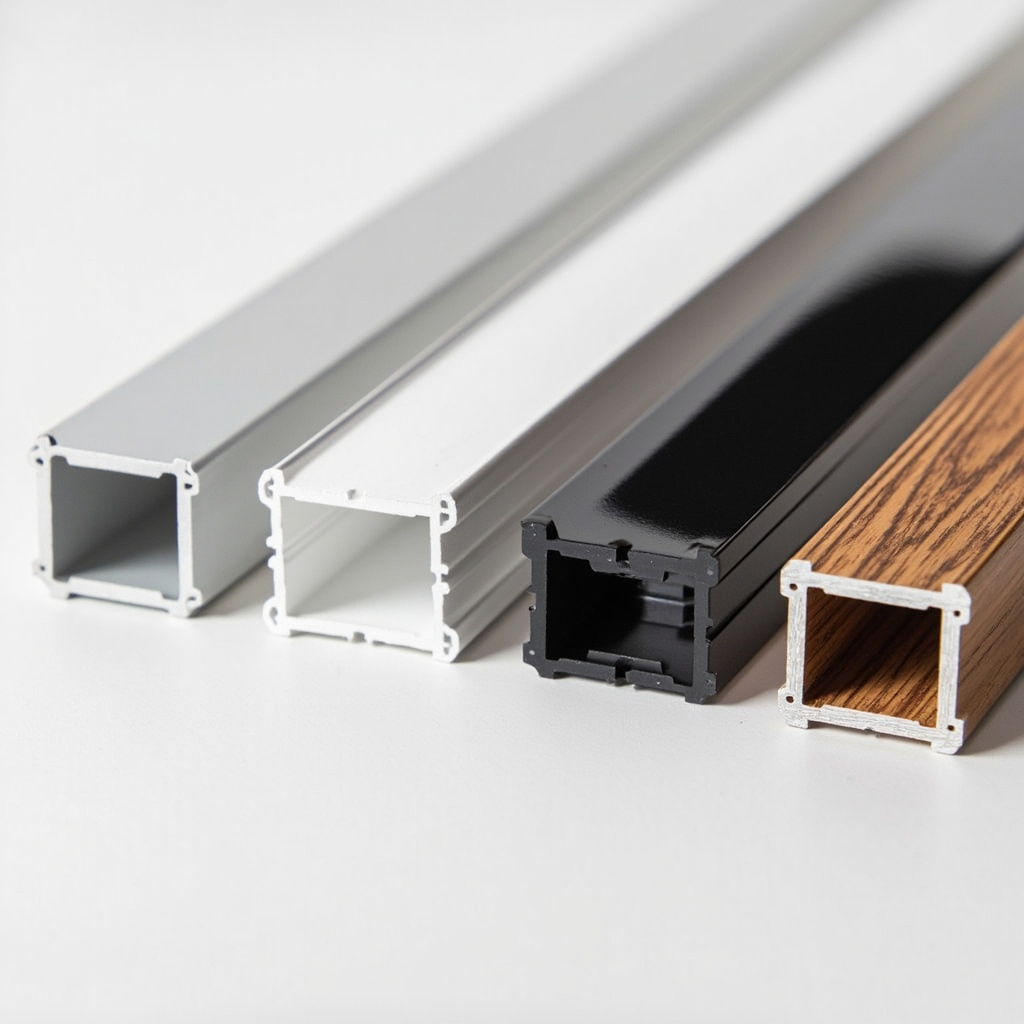
Surface treatment affects both aesthetics and durability. Specifically, the right choice depends on environment, design requirements, and budget.
| Treatment | Thickness | Durability | Color Options | Best For |
|---|---|---|---|---|
| Anodizing | 10–25 μm | 20–30 years | Silver, bronze, black, champagne (metallic tones) | High-end commercial, coastal environments, natural metallic appearance |
| Powder Coating | 60–80 μm | 20–25 years | Full RAL range (200+ colors), custom matches | Most common choice — residential, commercial, best cost-to-performance ratio |
| Fluorocarbon (PVDF) | ≥ 40 μm (2-coat) or ≥ 65 μm (4-coat) | 25–30+ years | Metallic, custom, high-gloss | High-rise curtain walls, UV-intense climates, premium projects |
| Electrophoretic (ED) | 12–25 μm | 20+ years | Limited (clear, bronze, black) | High-end residential, smooth finish, stain-resistant |
| Wood Grain Transfer | 60–80 μm base + sublimation | 15–20 years | Realistic wood textures (oak, walnut, teak, etc.) | Villas, resorts, wood aesthetic without maintenance |
Practical guidance:
- Standard urban environment: powder coating, RAL color of choice.
- Within 5 km of the sea: powder coating with QUALICOAT Seaside certification, or PVDF.
- High UV (tropical, high altitude): PVDF for maximum UV resistance.
- Wood look required: wood grain transfer on a powder-coated base.
QUALICOAT and QUALANOD specifications are maintained by QUALICOAT and QUALANOD.
8. Opening Types and Sealing Performance
The opening mechanism determines the sealing method, and the sealing method sets the ceiling for thermal and acoustic performance. Therefore, choosing the right opening type is just as important as choosing the right profile.
| Opening Type | Sealing Method | Thermal Performance | Sound Insulation | Best For |
|---|---|---|---|---|
| Casement (side-hinged) | Compression gasket — multi-point lock compresses seal uniformly around perimeter | Excellent | Excellent (35+ dB) | Bedrooms, living rooms, high-performance windows |
| Tilt & Turn | Dual-function: tilt for ventilation, turn for full opening. Compression seal when closed. | Excellent | Excellent (35+ dB) | European-style homes, secure ventilation, high-rise apartments |
| Sliding | Brush seals — sliding panels cannot achieve compression | Moderate (always lower than hinged) | Moderate (25–30 dB) | Patios, balconies, space-constrained openings, budget projects |
| Top-Hung (Awning) | Single-sided compression seal | Good | Good (30–32 dB) | Bathrooms, basements, ventilation during rain |
| Folding (Bi-fold) | Compression at hinges, brush between panels | Good to moderate | Good (30–32 dB) | Large openings, indoor-outdoor living, commercial entrances |
| Fixed (Picture) | No opening — sealed frame | Best | Best (35+ dB) | View-only windows, curtain wall panels, large glass facades |
The hierarchy is simple: compression-sealed openings (casement, tilt-turn) always outperform brush-sealed sliding openings. If energy efficiency and sound insulation matter, choose hinged. However, if space is the constraint, sliding is acceptable — but expect roughly 15–20% lower thermal performance.
9. 5-Step Profile Selection Framework
This is the decision path we use when a fabricator or contractor asks us for a recommendation. To make it repeatable, we break it into five steps.
Step 1: Determine the climate zone.
- Annual temperature variation < 15°C: non-thermal break may suffice for interior; thermal break for exterior.
- Variation 15–30°C: thermal break is mandatory for exterior windows. Use 60–70 series with 20 mm+ PA66 strips.
- Variation > 30°C: choose wide thermal breaks (24–34 mm). Use 70–80 series and consider triple glazing.
- Coastal/tropical: focus on corrosion resistance — QUALICOAT Seaside powder or PVDF. Specify 6063-T5 alloy with adequate wall thickness.
Step 2: Check building height and wind load.
- Below 6 floors: standard wind load class. Use 55–60 series.
- 6–20 floors: elevated wind load. Use 70 series minimum with 1.8 mm wall thickness.
- Above 20 floors: high wind load. Use 80+ series with 2.0 mm wall thickness and tested wind pressure class.
- Typhoon zones: consult local building code for design wind pressure. You may need 90+ series with reinforced sections.
Step 3: Match glass configuration to profile capacity.
- 55–60 series: handles double insulating glass up to 5+20A+5 (30 mm total).
- 70 series: handles double insulating up to 5+27A+5, or triple glazing 5+9A+5+9A+5.
- 80–90 series: handles triple glazing, laminated insulating, and heavy composite units.
Step 4: Select surface treatment based on environment.
- Standard urban environment: powder coating (60–80 μm, full RAL range).
- Coastal (within 5 km of sea): QUALICOAT Seaside powder, or PVDF.
- High UV (tropical, high altitude): PVDF.
- Aesthetic requirements (wood look): wood grain transfer.
Step 5: Verify hardware compatibility.
- European system windows: 15/20 mm Euro-groove hardware slot — accepts Roto, G-U, Siegenia, Maco.
- Chinese standard hardware: check groove dimensions match your hardware supplier.
- Multi-point locking: ensure profile chambers can accommodate espagnolette rods and shoot bolts.

10. Standards and Certifications
When evaluating suppliers of aluminum door and window profiles, these standards matter:
Material and Profile Standards
- GB/T 5237 — Chinese national standard for aluminum alloy extruded profiles (dimensional tolerances, mechanical properties, surface quality)
- GB/T 8478-2020 — Aluminum windows and doors standard (wall thickness, performance requirements)
- EN 755 / EN 12020 — European standards for extruded precision profiles
- EN 14024 — Thermal break profile mechanical integrity standard
- ASTM B221 — American standard for aluminum alloy extruded bars, rods, wire, profiles
- AAMA TIR-A8 — Structural performance of composite thermal barrier framing systems
Surface Treatment Certifications
- QUALICOAT — Quality label for powder coating on aluminum (Seaside class for coastal)
- QUALANOD — Quality label for anodized aluminum
- AAMA 2604 / 2605 — American architectural coating performance specifications
System and Performance Standards
- EN ISO 10077-1/2 — Thermal performance of windows, doors and shutters
- ASHRAE 90.1 — Energy standard for buildings (window U-factor requirements)
- NFRC 100 / 200 — North American window energy rating
- EN 14351-1 — Window and external pedestrian door product standard
Factory Certifications
- ISO 9001 — Quality management system
- ISO 14001 — Environmental management system
- CE marking — European conformity for products sold in the EU
11. Frequently Asked Questions
What is the minimum wall thickness for aluminum window profiles?
Per GB/T 8478-2020, exterior windows require ≥1.8 mm at main load-bearing sections. Interior windows require ≥1.4 mm. Exterior doors require ≥2.0 mm. Moreover, for buildings above 20 floors or high wind-pressure zones, 2.0 mm is recommended.
What is the difference between thermal break and non-thermal break profiles?
Thermal break profiles use a PA66 GF25 polyamide strip to separate interior and exterior aluminum sections, blocking heat transfer. As a result, frame U-value drops from 5.0–7.0 W/m²K (non-thermal break) to 1.8–3.2 W/m²K (thermal break). On the other hand, non-thermal-break profiles conduct heat directly, causing energy loss and condensation in cold weather.
What does the series number mean?
The series number indicates the profile’s cross-section width in millimetres. For example, a 70-series profile has a 70 mm frame depth. Larger numbers mean more internal space for thermal breaks, chambers, and glass units. However, series number alone does not guarantee quality — wall thickness and strip material are equally important.
Which aluminum alloy is best for window and door profiles?
6063-T5 is the industry standard for over 90% of aluminum door and window profiles worldwide. In fact, it offers the best balance of strength (≥157 MPa tensile), corrosion resistance, extrudability, and surface finish. Use 6061-T6 for structural applications and 6060-T66 for European precision systems requiring thin-wall extrusions.
How long do aluminum window profiles last?
With proper surface treatment (powder coating or anodizing at specified thickness), aluminum window profiles last 30–50 years with minimal maintenance. In addition, the surface coating typically carries a 20–25 year warranty. Furthermore, aluminum itself does not rust or degrade — the limiting factors are usually hardware, seals, and insulating glass units, which may need replacement after 15–20 years.
Can aluminum profiles be used in coastal areas?
Yes, but the surface treatment must be specified for salt spray resistance. For example, powder coating with QUALICOAT Seaside certification or PVDF fluorocarbon coating provides the necessary protection. Anodizing with ≥15 μm oxide film thickness is also suitable. Nevertheless, standard powder coating without Seaside certification may show pitting within 5–7 years in direct coastal exposure.
How do I verify profile quality from a supplier?
Request these documents: (1) material test report showing alloy grade and temper, (2) dimensional inspection report with wall thickness measurements, (3) surface treatment thickness certificate, (4) thermal break strip material certification (PA66 GF25, not PVC), and (5) relevant standards compliance (GB/T 5237, EN 14024, etc.). Additionally, physically measure wall thickness at main load-bearing sections and inspect surface finish for uniformity.
About Naview Aluminium
Naview Aluminium (Foshan Naview New Building Materials Co., Ltd.) has been manufacturing aluminum door and window profiles since 2005. Our 600,000 m² facility produces 300,000 tons of aluminum profiles annually, serving window fabricators, curtain wall contractors, and building material distributors in over 80 countries.
Our door and window profile capabilities include:
- 6063-T5/T6 and 6060-T66 alloy extrusion (22 extrusion lines, 1800–4000 ton press capacity)
- Thermal break profile assembly with PA66 GF25 strips (14.8–34 mm widths, EN 14024 certified)
- In-house powder coating (QUALICOAT certified), anodizing, PVDF, and wood grain transfer
- Custom profile design and die manufacturing for OEM/ODM projects
- Deep processing: CNC cutting, drilling, milling, and assembly-ready kits
Certifications: ISO 9001, ISO 14001, QUALICOAT, QUALANOD, CE, GB/T 5237 compliant.
Contact our technical team for profile specifications, custom extrusion quotes, or project consultations.
This article was written by the Naview Aluminium technical team with 20+ years of manufacturing experience. Technical data references GB/T 8478-2020, GB/T 5237, EN 14024, EN ISO 10077, and AAMA standards. Last updated: July 2026.
CONTACT US


Foshan Naview New Building Materials Co., Ltd.
We are always here offering customers our reliable products and service.
If you want to liaise with us now, please click contact us