
Aluminium Louvre Windows: Design & Buyer’s Guide
- By:Naview
- Date:2026-09-28
Aluminium Louvre Windows: Design & Buyer’s Guide
Aluminium louvre windows remain one of the most practical choices for projects that need controlled ventilation and rain defence. Their horizontal blade design lets fresh air flow while keeping direct rain out, making them common in schools, hospitals, factories, car parks and coastal homes. If you are specifying a commercial build or sourcing window systems for export, the following sections explain what matters most: blade profiles, frame alloys, weather ratings, hardware, glazing and ordering. Therefore, you can compare suppliers against the same technical criteria.
NA-VIEW produces aluminium louvre windows on six extrusion lines with daily capacity exceeding 500 profiles. Our team has supplied louvre systems to more than 30 countries over the past 11 years. Therefore, the guidance below reflects real factory experience rather than rewritten catalogue text.
What Are Aluminium Louvre Windows?
Louvre windows, also called jalousie windows in some markets, use multiple horizontal glass or aluminium blades set into a single frame. Specifically, each blade pivots around a central axis. Meanwhile, a single operating rod links the blades so that one handle opens or closes the whole bank at once.
Unlike casement or sliding windows, louvre blades do not swing into the room or slide along a track. Instead, they tilt upward to create a series of narrow openings. This layout gives three practical benefits:
- Cross-ventilation even when the blades are only partly open.
- Rain defence because the upward tilt deflects water outward.
- Adjustable airflow from full closure to wide open with one movement.
Modern aluminium louvre windows replace the old single-pane glass strips with thermally broken frames, double glazing and insect screens. Consequently, they now meet energy codes that older louvre systems could not satisfy. In addition, aluminium frames withstand salt air, UV and temperature cycling better than timber or PVC alternatives, which is why louvre banks in tropical and coastal zones are usually aluminium.
Another advantage is the small opening arc. Because blades tilt rather than swing, aluminium louvre windows can stay open during light rain without soaking the interior. This makes them ideal for schools, hospitals and public buildings where continuous background ventilation matters.
Blade Profiles and Standard Sizes
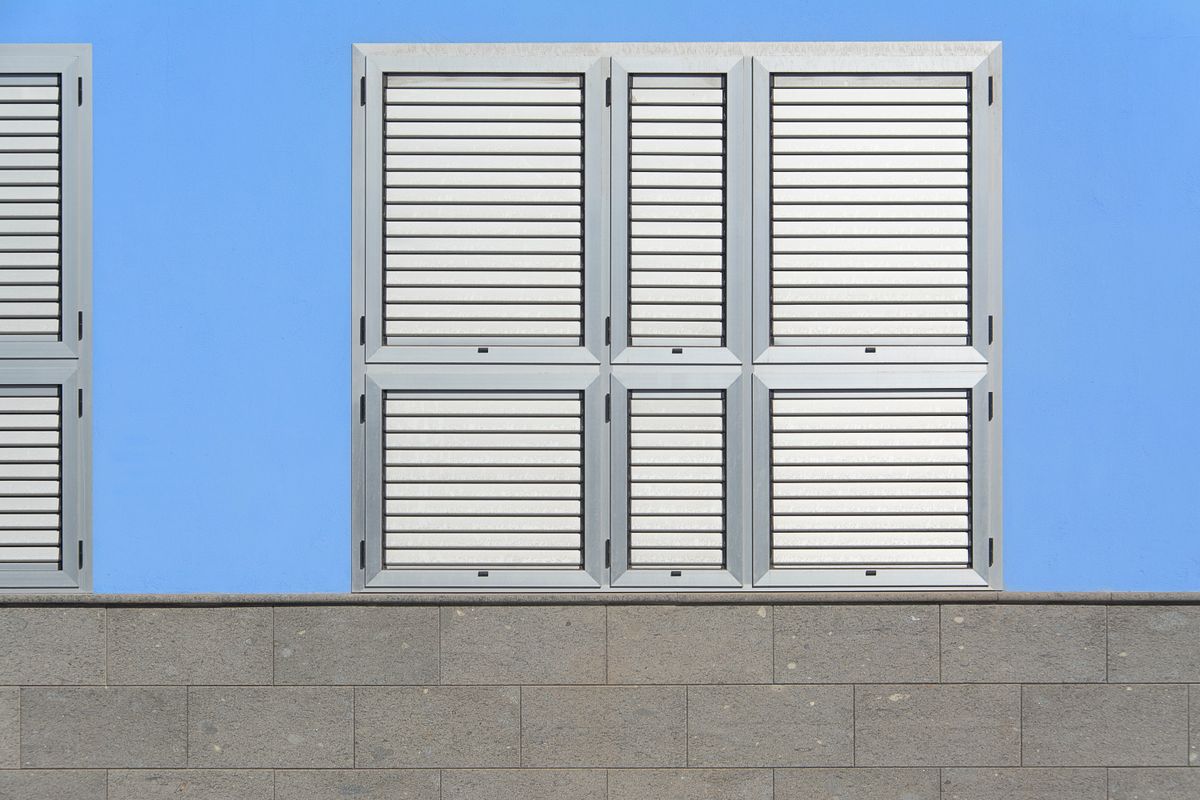
Blade selection determines airflow, water resistance and visual appearance. Generally, the most common blade widths for aluminium louvre windows are 102 mm, 152 mm and 203 mm. Each width suits a different wall depth and ventilation target.
At NA-VIEW, we extrude blades from 6063-T5 or 6063-T6 aluminium alloy. The 6063 grade offers excellent surface finish and corrosion resistance, while T6 temper increases strength for taller louvre banks. Wall thickness typically ranges from 1.2 mm to 2.0 mm depending on span and wind load.
| Blade width | Frame depth | Max blade span | Best use |
|---|---|---|---|
| 102 mm | 38 mm | 600 mm | Small service rooms, toilets, corridors |
| 152 mm | 50 mm | 900 mm | Offices, classrooms, standard residential |
| 203 mm | 65 mm | 1,200 mm | Large halls, factories, carparks, atriums |
Blade pitch, the centre-to-centre distance between blades, also affects performance. Tight 75 mm pitch improves water tightness but reduces free area. Meanwhile, wider 100 mm pitch increases airflow but needs better seals. Most project specifications settle on 85 mm pitch as a balanced choice.
Free area is the percentage of the total opening that remains open when blades are fully tilted. For a 102 mm blade at 75 mm pitch, free area is roughly 35%. A 152 mm blade at 85 mm pitch reaches 45% to 50%. Therefore, if your mechanical engineer needs 0.5 m² of free area per window, you must specify blade width and pitch accordingly. Otherwise, the installed window will not deliver the required airflow.
Material and Alloy Selection
The frame and blade material for aluminium louvre windows is usually 6063-T5 or 6063-T6. This alloy extrudes cleanly, accepts anodizing and powder coating well, and resists atmospheric corrosion. For coastal or industrial environments, 6063-T6 with a 25 µm anodized layer or a minimum 40 µm powder coat is the safer option.
Frames can be either non-thermal or thermal break. Overall, non-thermal aluminium louvre windows are cheaper and lighter, so they suit car parks, warehouses and plant rooms where U-value is less critical. Thermal break frames use a polyamide 66 barrier between inner and outer aluminium shells. This reduces heat transfer and prevents surface condensation. For air-conditioned offices and homes, thermal break frames are worth the extra cost.
Furthermore, thermal break bars must meet EN 14024 for material composition and dimensional stability. Poor-quality polyamide can soften during powder coating oven cycles and distort the frame. At NA-VIEW, we source PA66 GF25 from approved suppliers and check each batch for thermal conductivity and tensile strength. All NA-VIEW aluminium louvre windows comply with GB/T 8478-2020 for aluminium alloy windows and doors. We also follow EN 573-3 for alloy designation and EN 755-9 for extruded tolerance control. Mill certificates and EN 10204 Type 3.1 inspection reports are available on request.
Weather Performance: Air, Water and Wind
Specifiers often worry about water ingress. Properly engineered aluminium louvre windows handle rain through blade overlap, rear gutters and drainage channels. The key is to match the window rating to the project exposure.
European testing under EN 12207 classifies air permeability from Class 1 to Class 4. Water tightness follows EN 12208 from Class 1A to Class 9A. Wind resistance is covered by EN 12210 from Class 1 to Class 5. For protected inland locations, Class 2 air permeability, 3A water tightness and Class 3 wind resistance are usually enough. Exposed coastal or high-rise sites should reach Class 3 air permeability, 6A water tightness and Class 4 wind resistance.
Australian projects should reference AS 2047 for window performance and AS/NZS 1170.2 for wind loads. North American buyers often cite AAMA 611 for anodized aluminium finish and AAMA 2604/2605 for high-performance organic coatings. Always ask your supplier for test reports that match the standard named in the specification.
One common mistake when specifying aluminium louvre windows is to demand a high water-tightness class without checking whether the same louvre bank can also achieve the required airflow. Tighter seals reduce leakage but can restrict blade movement and free area. For each project, the engineer should decide which performance parameter is most critical and then select the blade profile, pitch and seals accordingly.
Screening, Security and Hardware
Most aluminium louvre windows need fly screens or security screens. Fixed insect mesh fits behind the blades and does not interfere with operation. Security screens use stainless-steel mesh or perforated aluminium sheeting. These can be hinged for cleaning access.
Hardware quality matters more than many buyers expect. The operating linkage carries the weight of every blade, so stamped-steel parts corrode and fail within a few years in coastal air. NA-VIEW uses 304 or 316 stainless-steel link rods, nylon bushings and die-cast zinc operators. Handle options include standard lever, multi-point key lock and chain-winder for high-level windows.
For electrically operated louvre banks, actuators can connect to building management systems. This allows automated night purge, smoke ventilation or CO2-driven airflow. When specifying motorised units, confirm the actuator torque rating, stroke length and IP rating.
Additionally, locking systems for aluminium louvre windows should resist forced entry. Multi-point locking cams pull the blades tight against the frame seal. For ground-floor or accessible locations, specify key-operated locks rather than simple hand levers. Some projects also need integrated alarm contacts or magnetic sensors for security monitoring.
Glazing and Acoustic Options
Traditional louvre windows used single 4 mm or 5 mm glass blades. Modern systems can accept double-glazed blades up to 24 mm overall thickness. Double glazing improves thermal insulation and reduces outside noise. Acoustic louvre windows use thicker glass, wider air gaps and acoustic seals to achieve sound reduction indices of Rw 35 dB or higher.
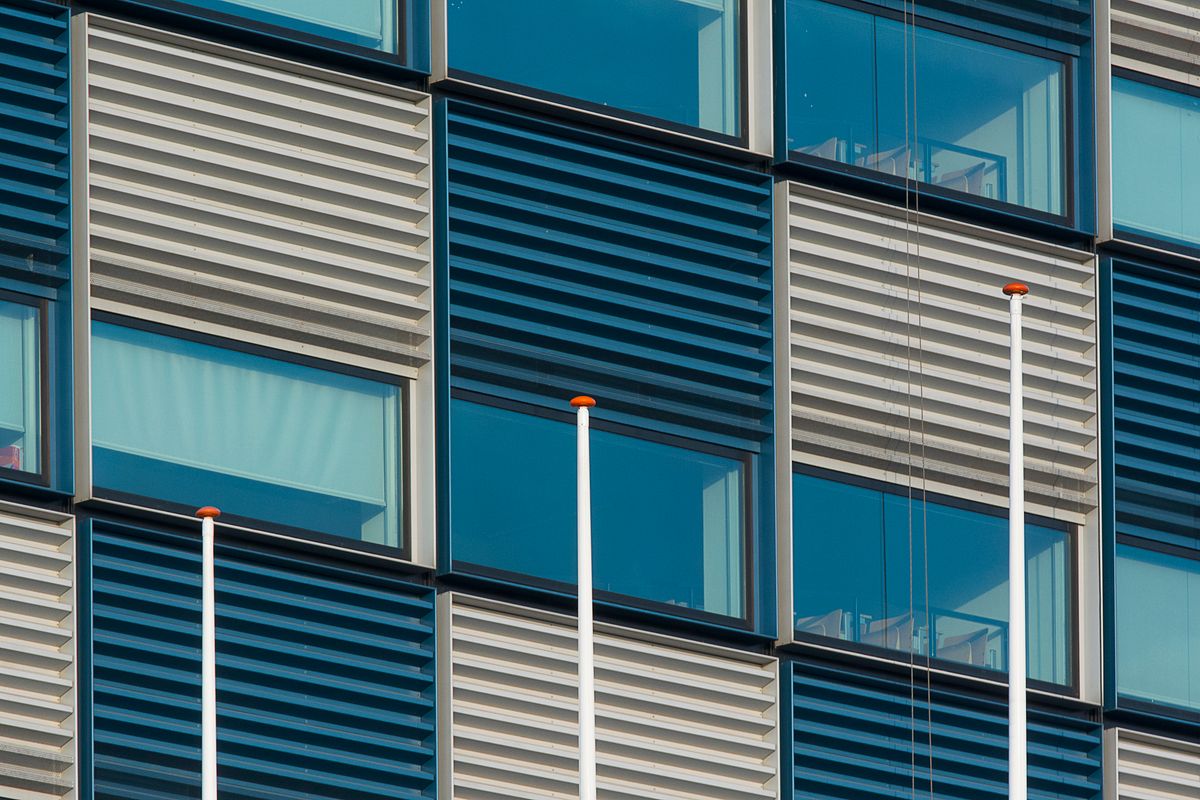
Other blade materials include:
- Clear toughened glass for maximum light and visibility.
- Tinted or reflective glass for solar control.
- Opacified glass for privacy in bathrooms and changing rooms.
- Solid aluminium blades for plant rooms, acoustic screens and louvre doors.
When you choose double glazing, check that the blade edge seal does not foul the frame during rotation. The rebate depth must accommodate the full glass thickness plus clearance. For louvre windows exposed to direct sun, low-emissivity coatings help reduce solar heat gain. Laminated glass is another option for safety and acoustic control. However, laminated blades are heavier, so the operating hardware and frame must be sized accordingly.
Energy Efficiency and U-Values
Energy efficiency in aluminium louvre windows depends on frame conductivity, glazing and blade overlap. A non-thermal aluminium frame with single glass can reach U-values around 5.5 W/m²K. With thermal break frames and double glazing, the same louvre bank can drop to 2.2–2.8 W/m²K.
Although louvre windows will rarely match a fixed casement window for pure thermal performance, they offer an advantage that sealed windows cannot match: free cooling. By opening automatically or manually during cooler night hours, aluminium louvre windows purge hot air and reduce air-conditioning load. This strategy works particularly well in mixed climates and buildings with high internal heat gains such as gyms, kitchens and data halls.
To improve U-value further, specify warm-edge spacers in double-glazed blades and thermal breaks wider than 18 mm. Also consider motorised operation linked to temperature sensors. Automated louvres can maintain indoor comfort with minimal energy input.
Comparison: Louvre, Awning and Sliding Windows
Buyers sometimes struggle to decide between louvre, awning and sliding windows. Each system suits different ventilation and budget goals.
| Feature | Aluminium louvre windows | Aluminium awning windows | Aluminium sliding windows |
|---|---|---|---|
| Ventilation control | Fine incremental adjustment | Limited to hinge angle | Fixed sash opening width |
| Rain defence | Good when blades tilt upward | Excellent, sash acts as canopy | Moderate, horizontal rail can hold water |
| Cleaning access | Easy from inside | Easy from inside | Requires reaching through sash |
| Thermal performance | Good with double glazed blades | Very good with thermal break frame | Very good with thermal break frame |
| Typical cost | Mid-range | Mid-range | Lower per square metre |
| Best application | Plant rooms, halls, bathrooms | Bedrooms, kitchens, offices | Apartments, standard bedrooms |
Overall, aluminium louvre windows win where you need high airflow and adjustable ventilation without the sash projection of an awning window. They are less ideal for full-height picture windows because the horizontal blades interrupt the view.
Typical Applications
Aluminium louvre windows appear in a wide range of building types. Commercial projects use them to ventilate plant rooms, stairwells, carparks and large atriums. For residential work, they suit bathrooms, laundries and kitchens where privacy and airflow must coexist. Schools and hospitals use them because the operating handle can be placed out of reach of children or patients while still allowing staff to control airflow.
Specialist uses include:
- Acoustic louvres on generator rooms and HVAC enclosures.
- Smoke vent louvres linked to fire control panels.
- Plantation-style shutters for architectural façades.
- Equipment screens that hide mechanical plant while maintaining airflow.
For each application, the specification should state free area percentage, water penetration rating, acoustic target and any fire-rating requirement. Without these details, suppliers cannot size the louvre bank correctly. Moreover, fire-rated aluminium louvre windows require intumescent seals and tested blade assemblies. These units are common in stairwell pressurisation and smoke ventilation schemes.
Surface Finishes and Colour Matching
Aluminium louvre windows can be finished in anodizing, powder coating, PVDF or wood-effect transfer. Anodizing gives a metallic look and excellent scratch resistance. Powder coating offers the widest colour range and is the most common choice for architectural projects. PVDF carries a longer colour warranty and is preferred for high UV exposure.
NA-VIEW stocks standard colours such as white, grey, black and bronze. Custom RAL or Pantone colours are available from 500 square metres of surface area. Samples can be sent within 3 days for colour approval before full production.
Furthermore, we offer wood-effect transfer finishes that mimic oak, walnut or teak for projects where aluminium needs to blend with timber cladding. These finishes are popular in hotels, resorts and high-end residential developments. However, wood-effect coatings need the same care as standard powder coating to avoid colour fading in tropical UV.
Installation and Sealing Details
Installation quality affects water tightness as much as the product itself. Frames should sit on packers to allow drainage and avoid direct contact with mortar. Perimeter gaps must be filled with neutral-cure silicone or expanding foam backed by a compression seal.
Head and sill flashings must extend beyond the frame width and slope outward. In high-rise or exposed locations, additional drainage slots in the sill are recommended. The frame fixings should be stainless steel or zinc-plated steel at 450 mm centres maximum, or closer near corners.
After fixing, check the operation of every blade before the wall is closed. Blades should open and close smoothly without rubbing the frame or adjacent blades. If a blade binds, the frame may be twisted or the operating rod may need adjustment. Rectifying these issues after the wall is finished is far more expensive than doing it during installation.
Cost Factors to Consider
The price of aluminium louvre windows depends on blade size, frame type, finish, glass and hardware. Small 102 mm blades in a non-thermal frame are the least expensive option. Moving up to 203 mm blades, thermal break frames and double glazing raises the cost significantly. However, the extra investment pays back through lower energy bills and longer service life.
Finish choice also affects budget. Standard powder coating in white or grey is the most economical. Metallic anodizing adds 10% to 15%. PVDF or custom RAL colours add 20% to 30%. For projects in harsh coastal zones, the higher corrosion resistance of anodizing or PVDF is usually worth the premium.
Glass upgrades change the price too. Single clear glass is standard. Tinted, reflective, laminated or low-e glass each adds cost but brings a specific performance benefit. When comparing quotes, make sure each supplier is pricing the same specification. A lower quote may use thinner blades, non-stainless hardware or lower-grade seals.
Maintenance and Longevity
Aluminium louvre windows need little maintenance compared to timber or steel units. Powder-coated frames should be washed with mild detergent and water twice a year in normal environments. In coastal or industrial atmospheres, quarterly washing removes salt or pollutants that could attack the finish over time.
Moving parts need occasional lubrication. Apply a light silicone spray to the operating rod, pivot pins and locking cams every 12 months. Avoid heavy grease because it attracts dust and can stiffen the mechanism. Furthermore, check the drainage slots in the sill every six months. Blocked drainage forces water into the wall and can cause staining.
With proper care, aluminium louvre windows from NA-VIEW will last 25 to 30 years. The powder coating warranty covers five years, but the aluminium frame itself can outlast two or three refurbishment cycles.
Designing the Window Schedule
A good window schedule for aluminium louvre windows makes production and installation smoother. Each line should include opening width, opening height, blade width, blade pitch, glass type, frame finish, performance class and quantity. Also note whether each unit needs screens, locks, motors or special sill details.
At NA-VIEW, we recommend grouping identical units together. Larger quantities of the same size reduce tooling changes and shorten lead time. For example, 50 identical 1200 × 900 mm louvre windows can run on one die setup. By contrast, 50 windows in 10 different sizes require multiple die changes and more quality checks.
Finally, leave room in the schedule for a prototype. A single sample unit lets the architect and builder confirm sight lines, colour and operation before full production begins. This step prevents costly changes later.
Ordering and Lead Time
When you request a quotation, send architectural elevations, a window schedule and the performance specification. If these are not ready, a clear hand sketch with dimensions and blade type is enough for budgeting. NA-VIEW returns detailed quotations within 24 hours and production drawings within 7 days after order confirmation.
Standard production lead time for aluminium louvre windows is 25 to 35 days. Large projects with custom colours or special glass may extend to 45 days. Samples of blades, finishes and hardware are free for serious buyers.
Why Choose NA-VIEW
NA-VIEW manufactures aluminium louvre windows from billet to finished frame. Our facility covers 600,000 square metres, runs six extrusion lines and produces more than 500 profiles per day. This vertical integration controls alloy quality, tolerances and delivery dates.
Our quality system is certified to ISO 9001. Every batch is checked for profile dimension, surface finish, glass thickness and hardware torque. We also support third-party inspections by SGS, Bureau Veritas or TÜV before shipment. To date, NA-VIEW has exported window and door systems to more than 30 countries, including Australia, the United States, Southeast Asia and the Middle East.
Beyond manufacturing, we help buyers with documentation. Our standard export package includes packing lists, commercial invoices, certificates of origin, mill test certificates and EN 10204 Type 3.1 reports. If your project needs specific test reports or third-party certification, we can coordinate with SGS, Bureau Veritas or TÜV before shipment.
Should your project need aluminium louvre windows, contact NA-VIEW for a fast quotation and free samples.
Frequently Asked Questions
What is the minimum order quantity for aluminium louvre windows?
Our standard MOQ is one 20-foot container, typically 80 to 120 square metres of windows depending on size. Smaller trial orders are negotiable for first-time buyers who want to verify quality before scaling up.
What payment terms do you offer?
We accept T/T, L/C at sight and PayPal for sample fees. Production orders usually require a 30% deposit before tooling and extrusion, with the balance paid against copy of bill of lading.
How do you ship aluminium louvre windows?
We quote FOB, CIF or DDP depending on your preference. Frames are wrapped in EPE foam and packed in steel-reinforced wooden crates. Glass blades are separated with cardboard dividers to prevent edge damage during transit.
How long does production take?
Standard aluminium louvre windows ship 25 to 35 days after drawing approval and deposit. Custom colours, special glass or large commercial contracts may extend lead time to 45 days.
Can I visit the factory before ordering?
Yes. We welcome factory audits and can arrange airport pickup from Guangzhou or Foshan. Many buyers combine a factory visit with inspection of existing projects in the region.
Do you provide installation instructions or support?
We supply installation drawings, fixing details and maintenance guides in English. For large projects, our engineers can provide online training or supervised start-up on site by arrangement.
What warranty do you offer?
We offer a 10-year structural warranty on aluminium frames and a 5-year warranty on powder coating. Glass and hardware carry the respective manufacturer warranties, which we pass on to the buyer.
CONTACT US


Foshan Naview New Building Materials Co., Ltd.
We are always here offering customers our reliable products and service.
If you want to liaise with us now, please click contact us